Your Network, the Coordinator, or a Placement Service
Olivet Nazarene University students have three routes to a preceptor: search their own networks as Olivet asks, turn to the SON Clinical Coordinator once the FNP page's 30-attempt mark is reached, or bring in a placement service. This page sets the three side by side so you can pick the route, or the mix, that fits your next course date.
Get your placement plan
Tell us your Olivet program and where you live. A placement advisor replies with the preceptor and site options that fit your Olivet course.
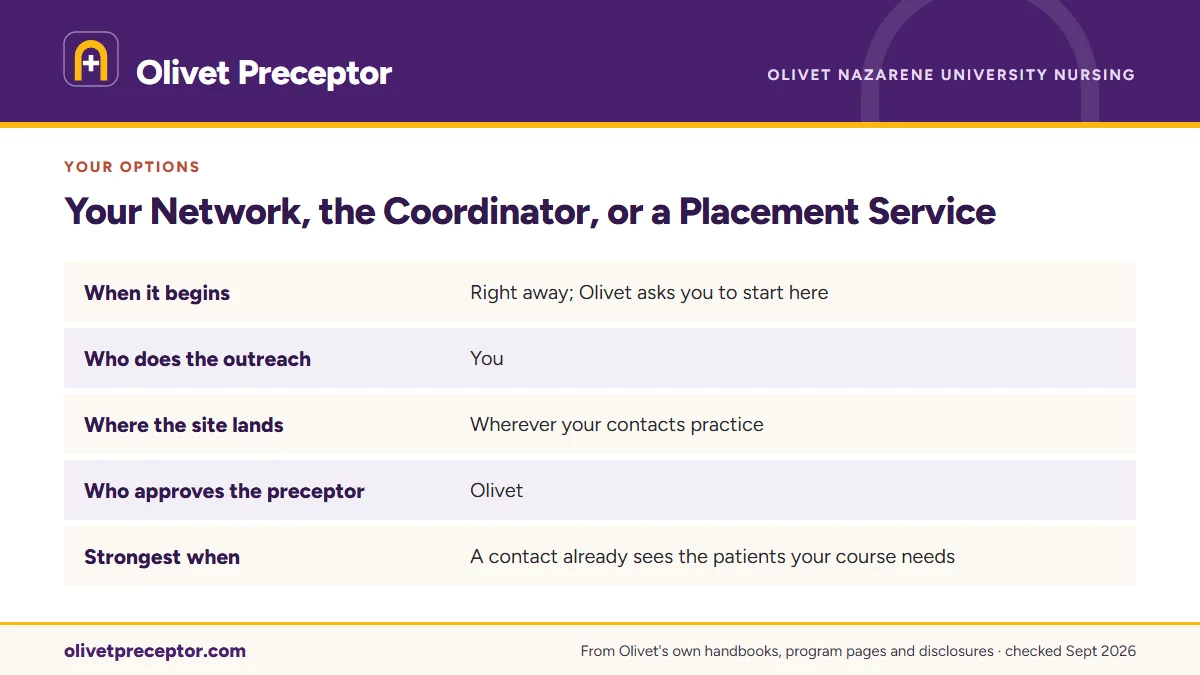
The three routes at a glance
Each route ends in the same place: a preceptor Olivet approves, in a state where your hours count. They differ in who does the outreach, when help begins and how much say you keep over where you train.
| Question | Your own network | SON Clinical Coordinator | Placement service |
|---|---|---|---|
| When it begins | Right away; Olivet asks you to start here | FNP page: after 30 unsuccessful attempts. PG-APRN and NEL pages: support with no attempt count | Whenever you ask |
| Who does the outreach | You | The coordinator, using the school's resources and networks | Your placement advisor and our placement desk |
| Where the site lands | Wherever your contacts practice | Possibly outside your preferred location, the FNP page warns | Within your drive radius, inside Olivet's approved states |
| Who approves the preceptor | Olivet | Olivet | Olivet |
| Strongest when | A contact already sees the patients your course needs | Your attempts are spent and you can travel | Your date is close or your network is thin |
Route one: your own network
This is where Olivet wants every online graduate student to begin. The FNP, post-graduate FNP and MSN Nursing Education & Leadership pages all encourage students to use their personal and professional networks to find a preceptor and practicum site first.
A network lead has real advantages. The preceptor may already know your work, the conversation starts warm, and a colleague at your own organization can sometimes answer faster than a stranger. For the graduate tracks, Olivet's handbooks are silent on training at your employer, so check with your faculty before counting on it; clinicals where you work covers what Olivet does say.
The work falls on you: matching each course's patient population, confirming the state is approved, securing a yes with a schedule attached, then gathering what approval asks for. Finding your own preceptor sets out a method if you take this route.
Route two: the SON Clinical Coordinator
Olivet's FNP page adds a safety net: a student unable to secure a preceptor after 30 attempts gets help from the SON Clinical Coordinator, using the school's own resources and networks. The same page cautions that a site found this way may sit outside the area the student would prefer.
Olivet words this differently by track. The post-graduate FNP and MSN NEL pages describe substantial support from the coordinator and state no attempt count at all. Read that as a difference in Olivet's published wording, and ask the coordinator which applies to you rather than assuming either version.
The coordinator route asks for patience and flexibility on distance. The 30-attempt rule looks closely at the threshold, and the SON Clinical Coordinator page describes the role more broadly.
Route three: a placement service
A placement service runs the outreach for you, from the first day you ask. We search within the distance you are willing to drive, check each site against Olivet's approved states, and bring you preceptors whose patients match the course. You speak with the preceptor before committing, and we prepare the credentials, license and site details your approval request needs.
Olivet still approves your preceptor, and you remain the student in its process. What changes is the time and guesswork on your side: you spend your weeks on coursework while the calls, follow-ups and paperwork move forward. The how it works page lays out each step, and the service stays with you through your hours, with a replacement search if a preceptor leaves.
Mixing the routes
You do not have to choose just one route. Keep your own warm leads for the course they suit and hand us a course your network cannot cover, for instance a pediatric or women's health clinical, where finding a practice with the right patient mix takes the most calls.
If you combine routes, send your placement advisor the list of practices you have already approached, so each office gets one clear request instead of two. Your course faculty and the coordinator remain your Olivet contacts whichever route produces the preceptor, and we coordinate our outreach around what you are already doing.
Five questions that settle the choice
- How many weeks remain before your next clinical or practicum course opens, counting the 2-to-4-week drug screen window?
- Does anyone in your network regularly see the patients this course is built around?
- Is your home area inside Olivet's approved states for your track?
- How far can you drive on clinical days, and would a distant site from the coordinator work for you?
- How many clinical courses are still ahead of you, and can one lead cover more than one?
If your honest answers are plenty of time, a strong lead and a short drive, start with your network. If the date is close, the lead is uncertain or several courses remain, adding our search early protects your start date. Send your track and course through the form and we will talk through the mix that suits you.
Questions Olivet students ask
Which route gets me a preceptor fastest?
It depends on your starting point. A network lead who already sees the right patients can be the quickest of all. The coordinator route begins only after the FNP page's 30 attempts, so it is rarely the fast one. A placement service begins outreach the day you ask, which suits students whose course opens soon or whose leads have gone quiet.
Can I use my own lead for one course and your search for another?
Yes, and many students do. Tell your placement advisor which courses your own leads cover, and we focus the search on the rest. We can still help with the approval details and the compliance calendar for a course you filled yourself, so every course in your sequence is ready on time.
Does Olivet review a preceptor found through a service any differently?
Olivet's approval applies to every preceptor you bring forward, and the criteria that count are the ones in your track's requirements course in Canvas. The program pages describe preceptors as approved and self-selected. A service's job is to make sure the preceptor you put forward fits those criteria and that the request arrives complete.
My network lead backed out a week before the course. What now?
Tell your course faculty right away, then send us the course number, start date and your location. We go straight to preceptors who can host on a short timeline, while you confirm your compliance items and drug screen are current. Need a preceptor fast walks through the first days of that search.
Related pages
Last checked 2026-09-25
We check these pages against Olivet's own handbooks, program pages, fee sheet and licensure disclosures. Your handbook version, your Canvas clinical requirements course, your faculty and the SON Clinical Coordinator have the final word.
Olivet asks you to start with your own network. We make the search the easy part of your program.
Tell us your Olivet track, where you live and when your next clinical course starts. We find preceptors whose patients fit the course, inside Olivet's approved states, and prepare everything Olivet's approval and the site's onboarding need.
- Preceptors matched to the course: adults and older adults for
NRSG 636C, women's health forNRSG 637C, children forNRSG 638C, education and leadership forNRSG 620 - Credentials, license and site details ready before your clinical course opens, with the drug screen timing on your calendar
- In your own community, in Illinois or any state Olivet approves for your clinicals
Start your placement plan
Track, city and start date is all we need to begin.