Project Concert: how Olivet tracks your clinical work
Project Concert is where Olivet Nazarene University follows the clinical side of your program. Olivet's fee sheet gives it two jobs: for FNP students, following competencies and recording each clinical encounter; for NEL students, following competencies alone. In the new curriculum it also verifies your compliance items, and new RN-BSN students upload several health records to it.
Get your placement plan
Tell us your Olivet program and where you live. A placement advisor replies with the preceptor and site options that fit your Olivet course.
Three jobs, depending on your program
Olivet mentions Project Concert in three documents, and each gives it a slightly different role. Find the row for your program; if you fit more than one, all of them apply.
| Program | Project Concert's role | Where Olivet says so |
|---|---|---|
| MSN FNP and Post-Graduate APRN (FNP) | Competency tracking, plus tracking and documentation of clinical encounters | School of Nursing fee sheet |
| MSN NEL and Post-Bachelor's NEL | Competency tracking | School of Nursing fee sheet |
| Graduate tracks under the new handbook | Verifies every compliance item you complete in Verified Credentials QualifiedFirst | New Curriculum MSN/PG-APRN handbook |
| RN-BSN, starts on or after August 23, 2026 | Holds Tdap, TB, BLS and health insurance proof | RN-BSN handbook, Fall 2026 |
Project Concert is one of several systems Olivet names for clinicals. Canvas holds your courses, your track's requirements course among them, and the student systems page maps where each piece sits.
FNP students: documenting encounters across four clinicals
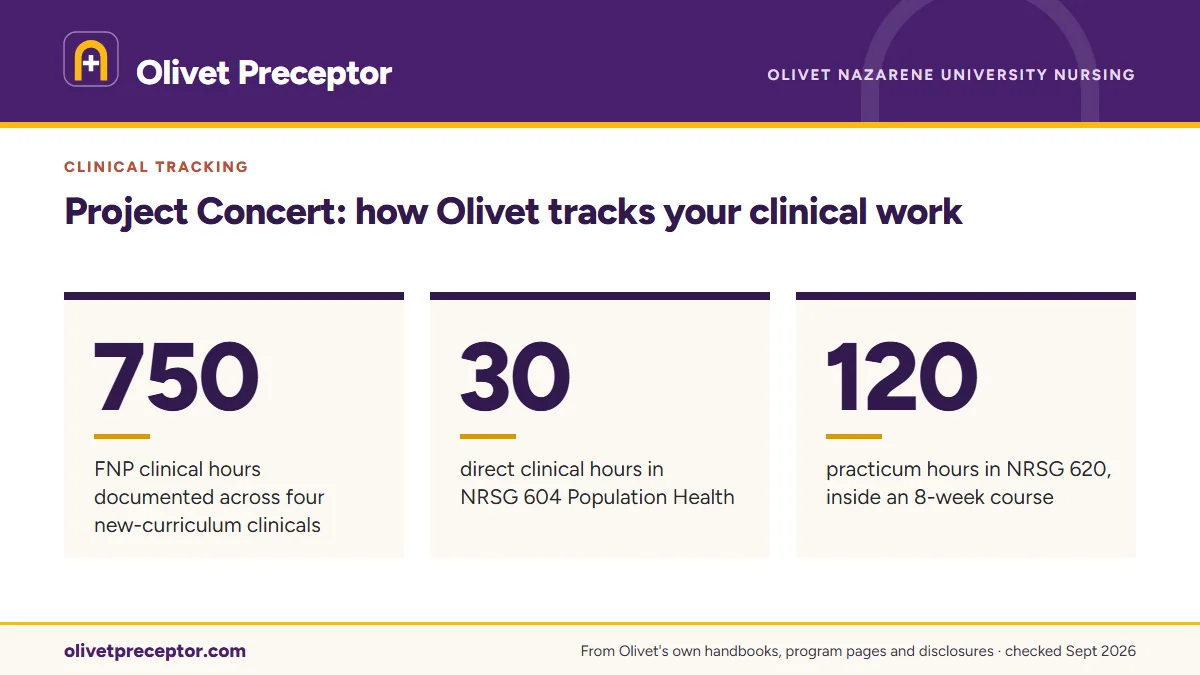
For the MSN FNP and the Post-Graduate APRN (FNP) certificate, Project Concert is where your clinical encounters are tracked and documented and where your competencies are followed across the program. In the new curriculum that work spans four population-focused clinicals, each paired with its didactic course.
| Clinical course | Hours | Patients you document |
|---|---|---|
| NRSG 636C Adult and Older Adult Primary Care Clinical | 240 | Adults and older adults |
| NRSG 637C Women's Health Primary Care Clinical | 135 | Women's health |
| NRSG 638C Pediatric Primary Care Clinical | 135 | Children |
| NRSG 639C Primary Care Across the Lifespan Clinical | 240 | Patients of every age |
Each FNP clinical ends in a Satisfactory or Unsatisfactory grade, and passing takes an 83% average across graded work plus every hour recorded as satisfactory. The record you keep is part of passing, not paperwork on the side. Current-curriculum students complete the same 750 hours across NRSG 665A to NRSG 665F; the 750 hours page compares both.
NEL students: competency tracking in two practicums
For the MSN Nursing Education & Leadership, the fee sheet lists Project Concert as competency tracking. The practicums are NRSG 604 Population Health, with 30 direct clinical hours, and the education and leadership practicum, NRSG 620, with 120 hours inside an 8-week course. A B- or better is needed in each.
The 8-week clock on NRSG 620 is what makes steady tracking worth the effort. Hours still owed at the end of week eight bring an X grade and a second eight-week stretch; past week 16, the course starts over. Updating your competencies week by week shows where you stand long before the final week, while there is still time to add practicum days.
Post-Bachelor's NEL students should note a separate conflict: the web page describes two practicums, while the handbook schedule shows only NRSG 620. The NRSG 620 page covers the practicum itself.
Compliance verification in the new curriculum
The New Curriculum MSN/PG-APRN handbook gives Project Concert a second role: it verifies all compliance items. You complete and maintain those items in Verified Credentials QualifiedFirst, and Project Concert confirms them before clinicals start.
Current-curriculum students keep their compliance in CastleBranch under their own handbook, one of the conflicts between the two editions that the clinical compliance page explains. Follow the handbook version that governs you.
New RN-BSN students use Project Concert more directly. Their Tdap, TB result, BLS card and insurance proof are uploaded to it directly, while the two screenings run through QualifiedFirst and have to be cleared ahead of NRSG 364. For them, Project Concert is first of all the place their health records sit.
Deadlines that shape your entries
- Olivet's online course week runs from Monday 12:01 a.m. CST to Sunday 11:59 p.m. CST, whatever time zone your clinic keeps.
- The last course day is the deadline for clinical and practicum assignments, at 11:59 p.m. Central.
- Every hour has to be documented as satisfactory for the course to be passed.
- Your preceptor may be asked for input, yet judging your outcomes is the faculty's job.
Students training in Mountain or Pacific time meet Olivet's Central deadlines an hour or two earlier by their own clocks. Record encounters on the day you see them rather than saving them for the course's final evening, and keep your own running total of hours so the last week holds no surprises.
If your preceptor's schedule changes and hours slip, the behind on clinical hours page covers the options inside an 8-week course.
What the fee sheet says about Project Concert
On Olivet's School of Nursing fee sheet, Project Concert is a student-paid item for the graduate tracks and for the RN-BSN. It appears beside the first-year compliance package, the yearly renewal and Clinical Student Validation, while charges tied to a particular site, a MyClinicalExchange fee for instance, are listed apart.
The same sheet lists DocuSign under fees covered by the university for signed document workflows, so Project Concert and document signing are separate lines. Amounts change from year to year; check the current fee sheet, and see our placement costs page for how each line fits together. For budgeting, the useful point is that Project Concert is a program cost you carry whichever preceptor or site you end up with, unlike parking, badges or a MyClinicalExchange charge, which depend on the site.
Starting Project Concert with a preceptor who fits the course
Documentation is easiest when the patients match the course. A preceptor whose clinic sees mostly adults makes NRSG 638C hard to document, however willing that preceptor is. We match Olivet students with preceptors whose patient mix fits the clinical you are in, so the encounters you record line up with the competencies Project Concert follows.
We also have the preceptor's credentials, license and site details ready before your course opens, and we stay on call if a preceptor drops mid-course, so your hours keep moving. Olivet approves every preceptor and its faculty grade your work; we make the route there straightforward. For NEL students we look for education and leadership preceptors whose setting suits the competencies of NRSG 620. Start with the form below.
Questions Olivet students ask
Do I pay for Project Concert myself?
Yes. Graduate nursing students and RN-BSN students see it on Olivet's fee sheet as a cost of their own, on a separate line from the compliance package and its yearly renewal. The fee sheet gives the current amount, and your requirements course is the place to ask about setup.
Is Project Concert part of Canvas?
They are separate systems. Canvas is where your courses run, including the requirements course that holds your track's practicum rules. Project Concert handles competency tracking, FNP clinical-encounter documentation and, under the new handbook, verification of compliance items. Expect to use both while you are in clinicals.
Does my preceptor need to use Project Concert?
Olivet's public materials describe Project Concert from the student's side. Faculty may ask preceptors for input on your performance, and how that input is collected is set out in your Canvas requirements course. Ask your course faculty before the first clinical day so your preceptor knows what, if anything, to expect.
Do NEL students record clinical encounters in Project Concert?
For NEL students the fee sheet's description stops at competency tracking; recording encounters is listed for the FNP tracks. The difference follows the practicums themselves, which for NEL students take place in population health, education and leadership settings. Your requirements course confirms exactly what to enter for NRSG 604 and NRSG 620.
What happens if my hours are not documented by the end of the course?
A clinical course is not passed until every hour is recorded as satisfactory, and the final course day at 11:59 p.m. Central is the cutoff for assignments. In NRSG 620, hours left at week eight mean an X grade and another eight weeks. For other courses, talk with your course faculty before the final week.
Related pages
Last checked 2026-09-25
We check these pages against Olivet's own handbooks, program pages, fee sheet and licensure disclosures. Your handbook version, your Canvas clinical requirements course, your faculty and the SON Clinical Coordinator have the final word.
Olivet asks you to start with your own network. We make the search the easy part of your program.
Tell us your Olivet track, where you live and when your next clinical course starts. We find preceptors whose patients fit the course, inside Olivet's approved states, and prepare everything Olivet's approval and the site's onboarding need.
- Preceptors matched to the course: adults and older adults for
NRSG 636C, women's health forNRSG 637C, children forNRSG 638C, education and leadership forNRSG 620 - Credentials, license and site details ready before your clinical course opens, with the drug screen timing on your calendar
- In your own community, in Illinois or any state Olivet approves for your clinicals
Start your placement plan
Track, city and start date is all we need to begin.