Olivet's graduate clinical placement process, from admission to your last logged hour
Every Olivet Nazarene University graduate nursing student moves through the same sequence before a first clinical day: a Canvas requirements course, a preceptor in an approved state, Olivet's approval, finished compliance and a site that has onboarded you. Here they are in order, with a link to the page that covers each one.
Plan your placement around Olivet's steps
Share your track, city and course start date.
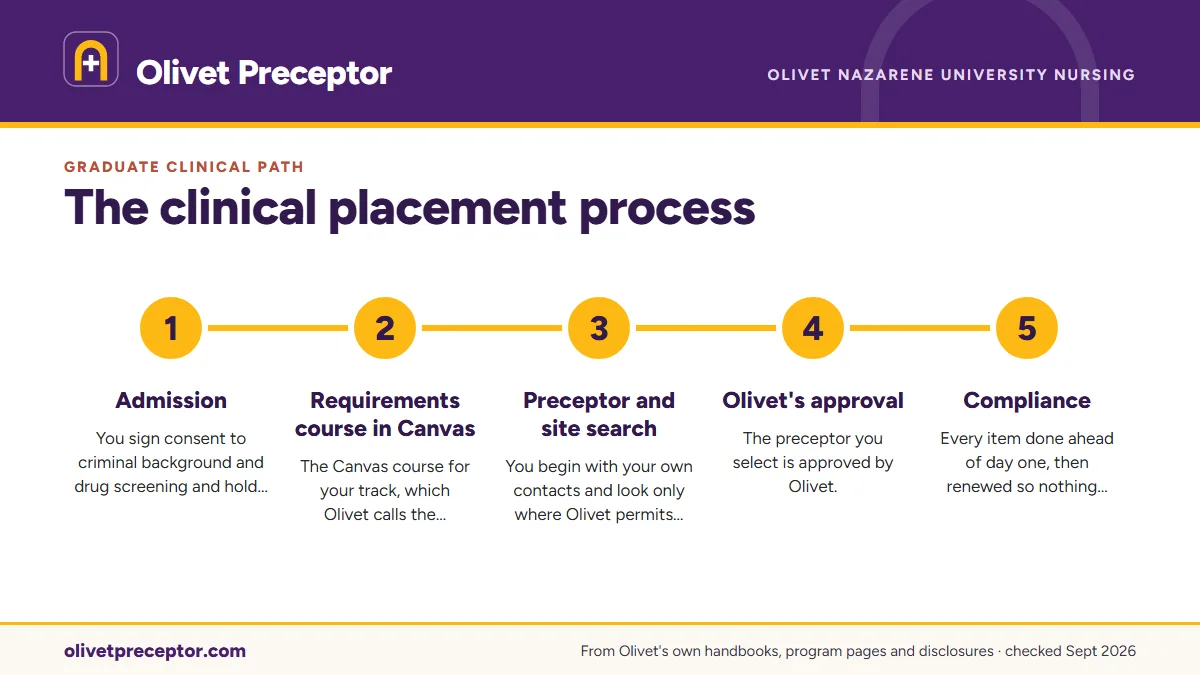
The sequence in one view
Olivet's graduate clinical path runs in a fixed order, and delays start when a later step is attempted before an earlier one is settled. It holds for all four online graduate tracks, whether you are in the MSN FNP or its Post-Graduate APRN (FNP) certificate, or in the MSN NEL or its Post-Bachelor's certificate. Where Olivet's two side-by-side curricula part ways, the step says so.
- AdmissionYou sign consent to criminal background and drug screening and hold a current, unencumbered RN license.
- Requirements course in CanvasThe Canvas course for your track, which Olivet calls the Student Clinical or Practicum Requirements Course, holds the practicum rules, and signing the handbook agreement binds you to them.
- Preceptor and site searchYou begin with your own contacts and look only where Olivet permits your practicum hours.
- Olivet's approvalThe preceptor you select is approved by Olivet.
- ComplianceEvery item done ahead of day one, then renewed so nothing lapses mid-course.
- Drug screenTimed so the result clears inside Olivet's window ahead of the practicum, with THC on the panel.
- Site onboardingThe site runs its own process, sometimes through MyClinicalExchange, and may add its own charges.
- Hours in Project ConcertYou record competencies, and for FNP courses clinical encounters, while the course runs.
- Evaluation and gradingFaculty judge your outcomes, drawing on preceptor input when they ask for it.
Before the search: admission items and the requirements course
Two things are settled before you contact a single clinician. At admission Olivet collects your signed consent to the background check and drug screening, and confirms your RN license is current and unencumbered, a status it has to keep for the whole program. An MSN student still short of 2,000 RN hours at admission has until NRSG 681 ends to reach that total or faces temporary withdrawal, so see where that date falls against your first clinical course.
The second is the Canvas course that holds your track's practicum rules. If you are in the new curriculum, Olivet adds you to it and sends an email invitation, which also shows up on your Canvas dashboard. In the current curriculum you join it yourself ahead of the role course, which is NRSG 627 on the FNP side and NRSG 629 on the Education side. The requirements course page compares the two routes.
Read it before you ask anyone to precept you, since the handbook agreement you sign makes its rules binding.
The search and the state check
Olivet's graduate program pages ask students to begin with their own personal and professional contacts, and they describe the preceptor as one you select and Olivet approves. How to work that network, and which patients or learners each course calls for, is on the finding your own preceptor page. FNP students who run out of leads have a defined fallback, the 30-attempt rule, after which the SON Clinical Coordinator takes over the search using Olivet's own contacts.
Location is checked at the same time as fit. Hours are meant to be local to you, and for FNP students local has to mean one of Olivet's approved states: 37 of them plus the District of Columbia. The 13 states on the other list are closed to FNP practicum hours whatever state you call home. The PG-APRN and NEL pages carry the approved-state requirement too, but the NEL pages name no states. Check yours on Olivet's licensure disclosures first.
Approval, then compliance
Once a preceptor agrees, Olivet approves them. The program pages settle who chooses and who approves; the paperwork itself, its route and its turnaround sit inside your Canvas requirements course. What to gather, and who to ask when an answer is slow, is on the preceptor approval page.
Compliance travels alongside approval: complete by day one, current to the end, and sometimes stricter at the site than on Olivet's own list. Where it lives depends on your curriculum. New-curriculum students use Verified Credentials QualifiedFirst, where Project Concert checks each upload; current-curriculum students use CastleBranch, background check included. Ask your advisor which handbook governs you. The full item list, from titers to in-person BLS, is on the clinical compliance page.
Olivet names two different compliance systems for the same items. Confirm your handbook version before you order or upload anything.
Timing the drug screen and the site's onboarding
The drug screen has the narrowest window in the whole process. Your result has to be back and cleared somewhere between four and two weeks ahead of the practicum, and THC is on the panel. Taken too early it misses the window; taken late it may not clear in time. A positive result is serious: withdrawal from all courses, a report to IDFPR and/or the licensing state, and six months away from clinical settings before reapplying.
Site onboarding is the step students most often leave out of their planning. Some sites use MyClinicalExchange, which carries its own platform charge, and a site may add a parking fee, an ID badge or a requirement for individual malpractice insurance. Onboarding belongs to the site, so ask early how long it takes. The MyClinicalExchange page explains what those sites ask of you.
While the course runs: Project Concert, evaluation and grades
Your hours and competencies go into Project Concert. For FNP courses Olivet's fee sheet describes it as tracking both competencies and clinical encounters, with documentation; for NEL it describes competency tracking alone. Logging habits are covered on the Project Concert page.
Your preceptor's view can inform your evaluation when faculty request it, yet judging your outcomes is the faculty's job. FNP clinicals carry a Satisfactory or Unsatisfactory grade. Across all clinical and practicum courses you need at least an 83% average on graded work, with every hour documented satisfactory, and the last assignment is due no later than 11:59 p.m. CST on the course's final day.
NRSG 620, the NEL practicum, runs on a separate clock: 120 hours due in 8 weeks, then an X grade with 8 extra weeks if you fall short, then a retake at the 16-week mark.
What Olivet leaves to the requirements course and your faculty
Olivet publishes the outline of the process; the working details sit behind your Canvas login. Use this table as your question list for the first week of the requirements course, and when the course itself leaves a point open, ask in writing and file the answer where you can find it again.
| Question | Where the answer lives | Who to ask |
|---|---|---|
| Name and fields of the graduate preceptor approval form | Canvas requirements course | Course faculty or the SON Clinical Coordinator |
| How long approval takes, and any submission deadline | Canvas requirements course | SON Clinical Coordinator |
| Site affiliation agreements for graduate clinicals | Not described publicly; DocuSign appears on the fee sheet | SON Clinical Coordinator |
| Faculty visits to clinical sites | Not described publicly | Course faculty |
| Which curriculum and handbook apply to you | Your enrollment record | Your advisor or the Online Advising Team |
Why Olivet students hand us the whole sequence
We are specialists in Olivet's clinical process and take on the parts that eat the most time. We find a preceptor whose patients or learners match your course, close to home and inside a state Olivet approves. We gather everything Olivet's approval will want to see about the preceptor and the site, learn the site's onboarding route, and set your drug screen window against your course start date.
Then we stay with you until the course ends. Should a preceptor leave partway through, a replacement is lined up and prepared for Olivet's review. Olivet has the final say on every preceptor, and our job is to send it a submission that is complete and matches its rules on the first pass. Tell us your track, city and start date using the form below.
Questions Olivet students ask
How early should an Olivet graduate student start the placement process?
Olivet does not publish a set lead time, so work backward from your course start. The drug screen alone has to clear weeks before the practicum, and approval, compliance and the site's onboarding all have to finish before that first day. Open your requirements course the day it appears.
Does the process differ for MSN Nursing Education & Leadership students?
The gates are the same, but the courses differ. NEL students complete the 30-direct-hour NRSG 604 Population Health course and the 120-hour NRSG 620 practicum. Their Project Concert use is limited to competencies, and the MSN NEL page promises substantial help from the Clinical Coordinator without an attempt count.
Do Post-Graduate APRN (FNP) certificate students follow the same steps?
Yes. New-curriculum certificate students complete the identical clinical sequence, 750 hours running from NRSG 636C to NRSG 639C, followed by the NRSG 688 Immersion. Some certificate students must first finish missing 3P courses. Their program page describes substantial support from the Clinical Coordinator but names no attempt threshold.
Does Olivet sign a contract with my graduate clinical site?
Olivet's public pages do not describe graduate affiliation agreements. DocuSign appears on its fee sheet for documents that need signatures, and the legacy RN-BSN process used an Agency Affiliation Agreement when a site needed one. If your site asks for a contract with the school, raise it with the SON Clinical Coordinator early.
Can I begin clinical hours while paperwork is still pending?
Plan on waiting. Olivet ties graduate hours to an approved preceptor, and its handbook wants compliance wrapped up ahead of day one, so hours logged before either is settled may not count. Wait until your approval, compliance record and site onboarding are all confirmed in writing, then start.
Related pages
Last checked 2026-09-25
We check these pages against Olivet's own handbooks, program pages, fee sheet and licensure disclosures. Your handbook version, your Canvas clinical requirements course, your faculty and the SON Clinical Coordinator have the final word.
Olivet asks you to start with your own network. We make the search the easy part of your program.
Tell us your Olivet track, where you live and when your next clinical course starts. We find preceptors whose patients fit the course, inside Olivet's approved states, and prepare everything Olivet's approval and the site's onboarding need.
- Preceptors matched to the course: adults and older adults for
NRSG 636C, women's health forNRSG 637C, children forNRSG 638C, education and leadership forNRSG 620 - Credentials, license and site details ready before your clinical course opens, with the drug screen timing on your calendar
- In your own community, in Illinois or any state Olivet approves for your clinicals
Start your placement plan
Track, city and start date is all we need to begin.