Olivet's Post-Graduate FNP certificate: clinicals on a short clock
Olivet Nazarene University's Post-Graduate APRN (FNP) certificate fits the full 750 FNP clinical hours into a 13-month online plan, and the first clinical arrives in the fifth course slot. For nurses who already hold an MSN, the preceptor search starts almost as soon as classes do, and that is exactly where we come in.
Start your certificate search
Share your 3P status and target start term, and your placement advisor will time the search to your first clinical.
Who the certificate is for
The certificate is built for registered nurses who already hold a master's in nursing and want to add the family nurse practitioner role. Olivet's admission list asks for an MSN with a 3.0 GPA, an active US RN license with no encumbrance on it, and signed consent to Olivet's background check and drug screening. Completers are prepared for the ANCC and AANPCB FNP certification exams.
The program page describes it as online, 13 months and 28 credit hours, with three starts a year, though the one date it lists is March 1, 2027. Length and credits both rise for a student who is missing prerequisite courses, which is where the 3P rules below come in.
RN experience matters here as well. The new-curriculum handbook sets a 2,000-hour RN practice requirement, and a nurse who has not reached it can still be enrolled conditionally. The MSN tracks tie that deadline to the end of NRSG 681, a course the certificate's sample order does not include, so ask your advisor exactly when your hours must be complete.
The 3P rules decide your start
3P stands for the three advanced courses every FNP needs: pathophysiology, pharmacology and health assessment. The new-curriculum handbook accepts earlier 3P coursework when at least two of the three were passed at B- or above and the third at no lower than C, all within five years. A student whose courses are older can take the one-time 3P Competency Assessment instead, which calls for 70% overall and 70% in each part.
Conditionally admitted students finish any missing 3P courses before the population-focused courses begin. In the current curriculum, PG-APRN students take the courses the handbook marks with an asterisk, beginning at NRSG 627, and the 3P courses can be skipped when they were passed in the last five years.
Your 3P status therefore sets the date of your first clinical. Settle it with your advisor early, because until it is settled your preceptor search cannot be timed to a real course date.
Bring these to the 3P conversation
- Transcripts showing grades for advanced pathophysiology, pharmacology and health assessment
- The completion date of each of those courses, to test the five-year window
- Whether you plan to sit the one-time 3P Competency Assessment
- Your target start term, so
NRSG 636Ccan be placed on a calendar
Four clinicals in quick succession
In the new-curriculum sample order, the certificate opens with NRSG 635 Professional Role Development of the FNP, followed by the pathophysiology and pharmacology pair, NRSG 643 and NRSG 644 in either sequence, and then NRSG 645. The first clinical sits in the fifth slot, and the other three follow one after another. The right-hand column is our suggested search plan, set against Olivet's course order.
| Slot | Course | Preceptor task |
|---|---|---|
| 1 | NRSG 635 FNP role development | Open the Student Clinical Requirements Course in Canvas; start the adult and older adult search |
| 2 and 3 | NRSG 643 and NRSG 644 | First preceptor chosen; approval materials assembled |
| 4 | NRSG 645 health assessment | Compliance finished; drug screen timed to clear 2 to 4 weeks before the clinical |
| 5 | NRSG 636 with NRSG 636C, 240 hours | Adult and older adult hours; women's health preceptor lined up |
| 6 | NRSG 637 with NRSG 637C, 135 hours | Women's health hours; pediatric preceptor lined up |
| 7 | NRSG 638 with NRSG 638C, 135 hours | Pediatric hours; lifespan preceptor confirmed |
| 8 | NRSG 639 with NRSG 639C, 240 hours | Final clinical, primary care across the lifespan |
| 9 | NRSG 688 FNP Immersion | Last course in the sample schedule |
The four clinicals add up to the same 750 hours the MSN FNP requires. Olivet does not publish how many weeks each clinical runs, so check every handoff against your actual course dates once your plan of study is set.
Two ways Olivet describes coordinator help
The certificate page opens the same way as the MSN pages: students are asked to lean on their personal and professional networks first, and each clinical is completed locally with an approved preceptor the student chooses.
The pages part ways on the backup. The PG-APRN page says the SON Clinical Coordinator gives substantial support and names no attempt threshold. The MSN FNP page, by contrast, brings the coordinator in after 30 unsuccessful attempts. Both are Olivet's own wording, so ask the coordinator which applies to certificate students in your term; the 30-attempt rule page explains the FNP version.
Whichever reading applies, the certificate's pace makes a slow search costly. With the first clinical in the fifth slot, a search that begins during NRSG 645 leaves very little time for approval, compliance and site onboarding before hours are due to start.
States, credits and audits
The certificate page requires practicum hours in an approved state. Olivet's out-of-state disclosure file lists 37 approved states plus the District of Columbia and 13 not approved, but the file mentions just the FNP track and is silent on whether certificate students fall under it. Treat that list as your working map and confirm through the FNPpracticum mailbox; our state list shows which states are affected.
Credit figures are a second conflict. The program page says 28 credits, the current-curriculum handbook sets 37 as the floor, and the new-curriculum handbook gives a 24 to 37 range for all certificates. The plan of study you receive through the Online Advising Team is the figure to go by.
Audits work as they do in the MSN FNP. Certificate students who audit a course can be asked to redo up to half its clinical hours, with the amount set jointly by the SON Clinical Coordinator and the program director for the FNP tracks, and any clinical more than two years old at completion can be called back for audit.
Why certificate students choose us
If your MSN career has been in education, leadership or an acute specialty, your network may not reach the primary care offices this certificate needs. We are built to close that gap on Olivet's timeline.
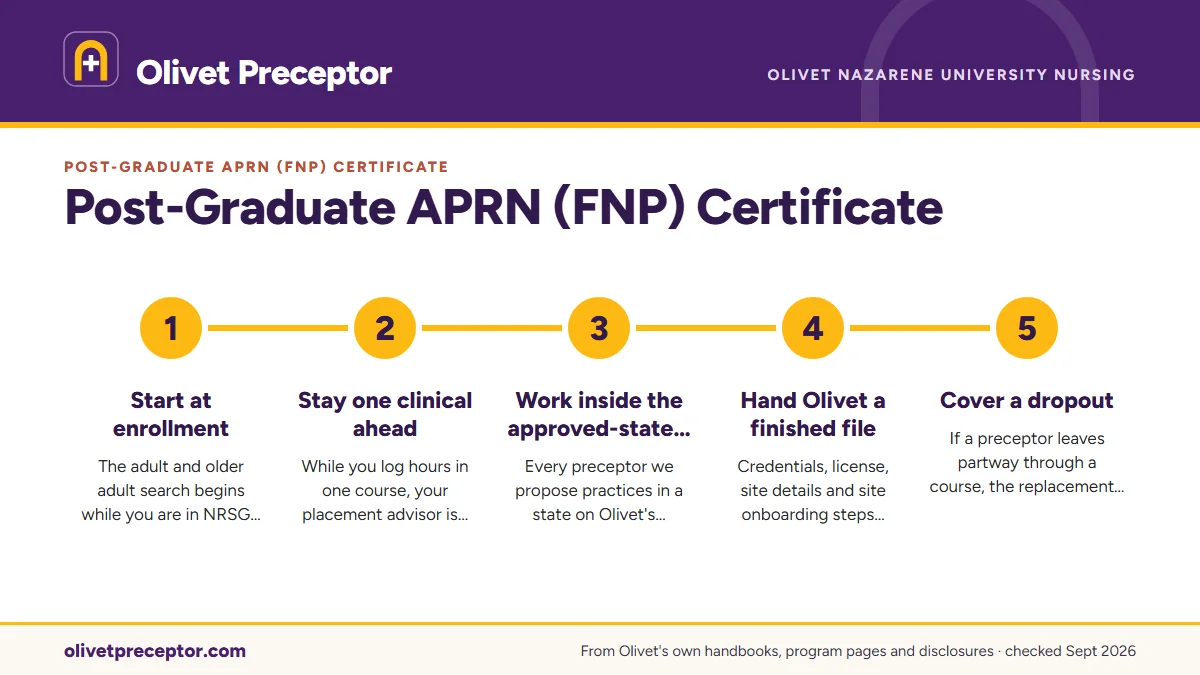
- Start at enrollmentThe adult and older adult search begins while you are in
NRSG 635, so approval is not squeezed into the days beforeNRSG 636C. - Stay one clinical aheadWhile you log hours in one course, your placement advisor is already confirming the preceptor for the next, from women's health through pediatrics to the lifespan course.
- Work inside the approved-state mapEvery preceptor we propose practices in a state on Olivet's approved list, with Kansas's added requirements flagged where they apply.
- Hand Olivet a finished fileCredentials, license, site details and site onboarding steps, including MyClinicalExchange where a site uses it, are gathered so Olivet reviews a complete packet.
- Cover a dropoutIf a preceptor leaves partway through a course, the replacement search starts right away.
Olivet signs off on each preceptor; our part is making sure the file it reviews has nothing missing and matches its rules on the first submission. Tell us your 3P status and target start in the form below.
Questions Olivet students ask
Can I get into the Post-Graduate FNP certificate with old 3P courses?
Yes, through the competency route. 3P coursework older than five years does not meet the handbook rule on its own, but the one-time 3P Competency Assessment lets you show current knowledge instead, with 70% needed overall and in each part. Students admitted conditionally complete any missing 3P courses before the population-focused clinicals, which moves the first clinical later.
Are the certificate clinicals the same as the MSN FNP clinicals?
In the new curriculum, yes: the same four clinicals, NRSG 636C to NRSG 639C, totaling 750 hours, with the FNP Immersion to close. What differs is everything before them. The certificate skips the MSN core and moves from role development and the 3P courses straight into clinicals, so the preceptor search has to start far sooner than it does for MSN students.
How long does Olivet's Post-Graduate FNP certificate take?
Olivet's page gives 13 months for a student who meets every prerequisite. Missing prerequisite courses add time and credits, and a slow preceptor search can push a clinical into a later term. Settling your 3P status early and having each preceptor approved before the matching clinical opens are the two biggest levers on finishing close to that 13-month mark.
Do certificate students walk at Olivet's commencement?
No. Per the new-curriculum handbook, commencement is not part of the certificate path; Olivet holds it only in May, for MSN graduates. For a certificate student, the practical finish line is the last clinical hours logged and the FNP Immersion complete, which then opens the way to the ANCC or AANPCB certification exam.
Do I need my own malpractice insurance for certificate clinicals?
The new-curriculum handbook asks FNP and PG-APRN students to carry malpractice insurance only when the clinical site requires it, with coverage minimums spelled out in the handbook. Separately, the fee sheet shows student professional liability insurance in the FNP section and counts a personal malpractice policy among charges a site might add, so ask each site early what it expects.
Related pages
Last checked 2026-09-25
We check these pages against Olivet's own handbooks, program pages, fee sheet and licensure disclosures. Your handbook version, your Canvas clinical requirements course, your faculty and the SON Clinical Coordinator have the final word.
Olivet asks you to start with your own network. We make the search the easy part of your program.
Tell us your Olivet track, where you live and when your next clinical course starts. We find preceptors whose patients fit the course, inside Olivet's approved states, and prepare everything Olivet's approval and the site's onboarding need.
- Preceptors matched to the course: adults and older adults for
NRSG 636C, women's health forNRSG 637C, children forNRSG 638C, education and leadership forNRSG 620 - Credentials, license and site details ready before your clinical course opens, with the drug screen timing on your calendar
- In your own community, in Illinois or any state Olivet approves for your clinicals
Start your placement plan
Track, city and start date is all we need to begin.