Olivet clinical compliance: the whole list and when each item is due
Olivet Nazarene University expects every compliance item done by the day your clinicals open and kept up to date until the final one. This page gathers the graduate list from Olivet's handbook into one table, shows which system holds your records under each curriculum, and flags the items that tend to expire in the middle of a clinical sequence.
Get your placement plan
Tell us your Olivet program and where you live. A placement advisor replies with the preceptor and site options that fit your Olivet course.
The standard: finished before day one, current until the final hour
Olivet's New Curriculum MSN/PG-APRN handbook holds four graduate programs to a single standard: both FNP routes, the MSN and the post-graduate certificate, and both Nursing Education & Leadership routes, the MSN and the post-bachelor's certificate. Nothing may be missing on the first day you report to a site, and nothing may lapse while your clinical courses run. A file that was perfect in the spring can fall short by fall if a TB result or a flu season runs out.
The work begins at admission, long before a preceptor is in the picture. You give written consent to criminal background screening and drug testing, and you hold a current, unencumbered RN license. After that, the Canvas course Olivet calls the Student Clinical or Practicum Requirements Course, one for each track, spells out the practicum rules in detail, and signing the handbook agreement makes that course binding. How you get into it differs by curriculum; the requirements course page explains both routes.
Treat Olivet's list as the minimum. The handbook says plainly that a clinical site may require more than Olivet does, so the site you land at can stack its own onboarding items on top.
Olivet's graduate compliance items in one table
This table follows the new-curriculum handbook, which is the fullest published list. Current-curriculum students complete the same items through a different vendor, covered in the next section.
| Item | What the handbook asks for | Renewal or timing |
|---|---|---|
| Criminal background check | Run under the consent signed at admission | On file before clinicals; a flagged result is shared with sites |
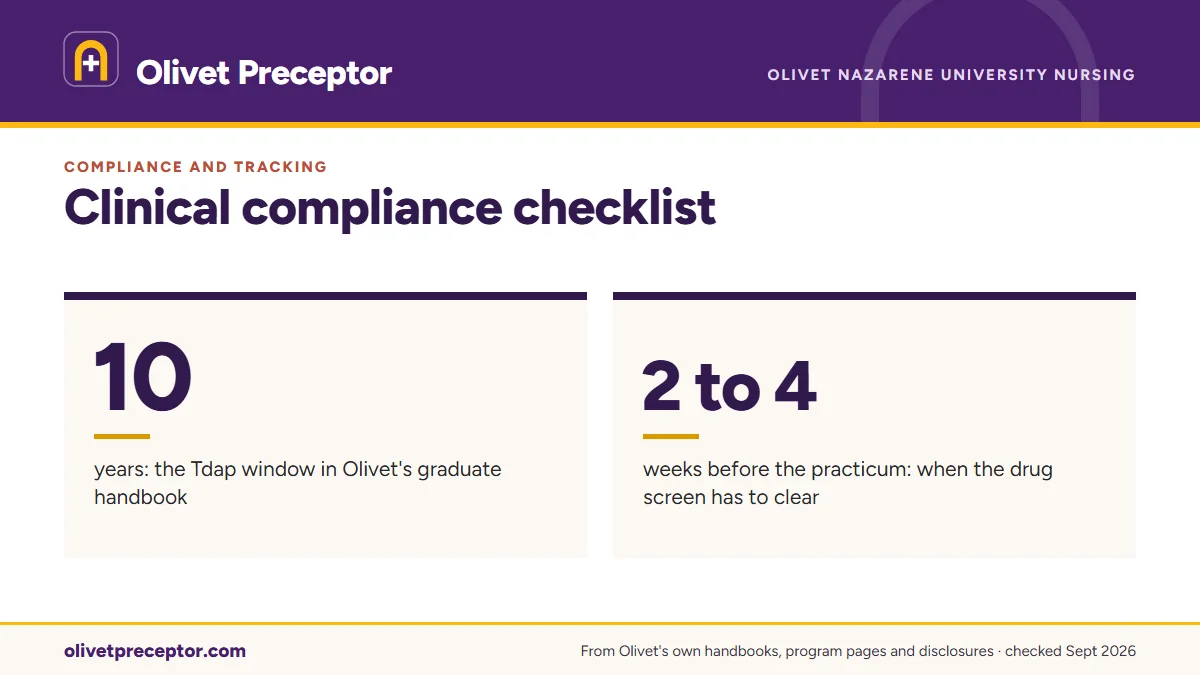
| Drug screen | Includes THC | Cleared 2 to 4 weeks before the practicum starts |
| Physical exam | By an NP, MD, DO or PA, recorded on Olivet's Health and Immunization Form | As your requirements course directs |
| TB screening | Negative 2-step TB, T-SPOT, QuantiFERON Gold or chest x-ray | Every year |
| MMR, varicella, hepatitis B | Positive titers; a negative titer means a booster and a repeat titer | Lab report kept on file |
| Tdap | Given within the past 10 years | Ten-year window |
| Influenza vaccine | A declination needs a provider's medical statement | Every year |
| BLS | American Heart Association card from an in-person class | Valid through the whole practicum |
| Health insurance | Personal coverage | Active throughout |
| RN license | Current and unencumbered | Active throughout; changes reported |
| Malpractice insurance | FNP and PG-APRN students, only when the site requires it | Set by the site and the handbook's minimum limits |
One rule covers every upload: each file must carry your name and demographic details along with the result and when it was recorded. A lab printout without your name, or a vaccine card with no date, does not meet that rule, so look at each file before it goes in.
Which system holds your records: your handbook decides
Olivet runs two MSN curricula side by side, and their handbooks name different compliance vendors. Olivet's handbook for new starts, the New Curriculum edition from August 2026, calls Verified Credentials QualifiedFirst the University's designated compliance management system and adds that Project Concert verifies every item. The edition for continuing students, the Current Curriculum handbook dated 8/31/26, sends those same items, the background check among them, to CastleBranch.
Both documents are Olivet's, both are current, and they disagree. The practical answer is to follow the handbook version that governs your own enrollment, and to ask the Online Advising Team or the SON Clinical Coordinator if you are unsure which one that is. New-curriculum students can read the QualifiedFirst guide, continuing students the CastleBranch guide, and everyone uses the Project Concert guide for tracking.
Two Olivet handbooks name two different compliance vendors. Use the system your own handbook version names, even if a classmate uses the other one.
The items that expire while you are in clinicals
A new-curriculum FNP student works through four clinical courses, NRSG 636C to NRSG 639C, for 750 hours. A current-curriculum FNP student works through six, NRSG 665A to NRSG 665F. Either route lasts long enough for yearly items to come due partway through, and the standard is current throughout, not current on the first day.
Put these dates on your calendar
- TB: a negative result is needed every year, so the date of your last test sets a hard deadline.
- Flu vaccine: yearly, so a course that crosses into a new season needs the new dose on file.
- BLS: the card must stay valid through the entire practicum, not only on day one.
- Drug screen: the result has to clear inside a window that opens four weeks and closes two weeks ahead of the practicum; your requirements course explains how that works across several courses.
- Compliance renewal: Olivet's fee sheet lists a yearly renewal after the first-year compliance package.
Timing for the screen is set out on the drug screen page, and each vaccine, titer and TB option is on the immunizations and TB page.
What clinical sites stack on top of Olivet's list
Olivet's fee sheet shows the kinds of extras a site can bring. Some sites onboard students through MyClinicalExchange, which has its own platform charge at the sites that use it. Sites may also charge for parking or an ID badge, or ask you for individual malpractice insurance. The site decides these, not Olivet, and you learn them once a site is chosen.
The fee sheet also lists what every graduate student carries regardless of site: the first-year clinical compliance package (background check, drug screen and compliance tracking), the yearly renewal, Clinical Student Validation, CPR, titers and vaccines, the physical exam, health insurance and Project Concert.
Site onboarding runs on the site's schedule, so confirming the site early gives you the most room to finish its steps. How MyClinicalExchange sites work is covered on the MyClinicalExchange page.
RN-BSN and Traditional BSN students work from different lists
In the RN-BSN, the handbook for starts from August 23, 2026 onward has screening instructions arrive by email while you take NRSG 302 or soon after. Both screenings run through Verified Credentials QualifiedFirst, need to be cleared by the opening of NRSG 364, and then stay good for a year of clinical hours. Proof of Tdap, TB testing, BLS and health coverage is uploaded to Project Concert, as is anything a site adds.
Traditional BSN students on the Bourbonnais campus repeat the background check and drug screen every year, complete a three-dose hepatitis B series, and must have health compliance cleared before admission to the major. The Level 0 handbook is blunt about gaps: a student who falls short on compliance is withdrawn from the level and has to take it again.
Why Olivet students choose us to keep compliance on schedule
We build your compliance calendar around the actual placement. As soon as a preceptor, a site and a first clinical day are in view, we set out when your drug screen must clear, which yearly items expire during the course, and what the site's onboarding adds, so week one holds no surprises.
Alongside that, we assemble what the approval step and the site's onboarding call for: your license details, the preceptor's credentials, the site information and any MyClinicalExchange steps. Olivet decides on every preceptor, and the file it reviews from us is complete and matched to its rules from the start. Send your track and start date through the form below and we will lay out your timeline.
Questions Olivet students ask
How early should I start my Olivet compliance items?
Olivet's rule is about the finish line, not the start: nothing missing when your first clinical day arrives. Titers are the item to start first, because a negative result means a booster and a repeat titer before the item is done. The drug screen is the exception, since its result has to land in the two-to-four-week window ahead of the practicum, so testing too soon is a real risk.
Can a clinical site ask for items Olivet does not require?
Yes. Olivet's handbook states that sites may require more than Olivet does. Common additions on the fee sheet include onboarding through MyClinicalExchange, parking, an ID badge and individual malpractice insurance. Ask the site what it requires as soon as a preceptor agrees, so its list and Olivet's are finished together.
Is the compliance list the same for NEL students as for FNP students?
The new-curriculum handbook applies its compliance list to the MSN, PG-APRN, NEL and Post-Bachelor's NEL tracks alike. The one item written for FNP and PG-APRN students only is malpractice insurance when a site requires it. NEL students complete the list before NRSG 604 Population Health and keep it current into NRSG 620.
What if a compliance item expires during my practicum?
The handbook's standard is current throughout, so an expired item leaves your record short of it. Renew annual items like the TB test and flu shot ahead of any clinical course that would run past their dates, and keep BLS valid to your last clinical day. Your requirements course and course faculty explain how Olivet handles a lapse.
Do I need malpractice insurance for Olivet clinicals?
Only in some cases. The handbook calls for it from FNP and PG-APRN students whose site asks, with minimum limits written into the handbook. The fee sheet adds two more lines: student professional liability coverage shown among fees covered by the university, and an individual policy shown as a possible site charge. The malpractice insurance page sets out all three.
Related pages
Last checked 2026-09-25
We check these pages against Olivet's own handbooks, program pages, fee sheet and licensure disclosures. Your handbook version, your Canvas clinical requirements course, your faculty and the SON Clinical Coordinator have the final word.
Olivet asks you to start with your own network. We make the search the easy part of your program.
Tell us your Olivet track, where you live and when your next clinical course starts. We find preceptors whose patients fit the course, inside Olivet's approved states, and prepare everything Olivet's approval and the site's onboarding need.
- Preceptors matched to the course: adults and older adults for
NRSG 636C, women's health forNRSG 637C, children forNRSG 638C, education and leadership forNRSG 620 - Credentials, license and site details ready before your clinical course opens, with the drug screen timing on your calendar
- In your own community, in Illinois or any state Olivet approves for your clinicals
Start your placement plan
Track, city and start date is all we need to begin.