Verified Credentials QualifiedFirst: Olivet's new-curriculum compliance system
If your Olivet Nazarene University handbook is the New Curriculum MSN/PG-APRN edition, your clinical compliance lives in Verified Credentials QualifiedFirst, and Project Concert verifies what you put there. New RN-BSN students use QualifiedFirst as well, for the background check and drug screen. Here is who uses it, what goes in, and how to get each upload accepted on the first review.
Get your placement plan
Tell us your Olivet program and where you live. A placement advisor replies with the preceptor and site options that fit your Olivet course.
Who uses QualifiedFirst at Olivet
Olivet's August 2026 handbook for new MSN and PG-APRN starts gives QualifiedFirst an official title: the University's designated system for managing compliance. Anyone governed by that edition builds and keeps up every clinical compliance item there. In practice that means new-curriculum FNP students, whether in the master's or the post-graduate certificate, and new-curriculum Nursing Education & Leadership students in the MSN or the post-bachelor's certificate.
RN-BSN students whose program began from August 23, 2026 onward use QualifiedFirst too, in a narrower way: only the background check and drug screen go through it, and students pay the vendor directly for both.
One conflict matters here. The handbook written for continuing MSN students, revised on 8/31/26, points the same items at CastleBranch. Two Olivet documents from the same month point to two vendors, so follow the handbook version that applies to you and ask your advisor on the Online Advising Team if you cannot tell. Continuing students should read the CastleBranch guide instead of this one.
QualifiedFirst belongs to the new curriculum. If your handbook is the Current Curriculum edition, your records go to CastleBranch.
What goes into your QualifiedFirst record
For graduate students the new-curriculum handbook puts the whole compliance list into QualifiedFirst. This is the upload checklist; the timing for each item is on the clinical compliance overview.
- The criminal background check, run under the consent you signed at admission
- The drug screen, with THC on the panel
- Your physical, done by an NP, MD, DO or PA, with the findings entered on Olivet's Health and Immunization Form
- A negative TB result from a 2-step test, T-SPOT, QuantiFERON Gold or chest x-ray
- Titer reports for MMR, varicella and hepatitis B
- A Tdap dated within 10 years and this year's flu vaccine
- An American Heart Association BLS card from a class taken in person
- Proof of personal health insurance
- Your current, unencumbered RN license
- Malpractice insurance, for FNP and PG-APRN students whose site requires it
How Project Concert checks what you submit
The new-curriculum handbook adds a second layer: Project Concert verifies all compliance items. You build and maintain the record in QualifiedFirst, and Olivet's tracking system confirms it. Olivet's fee sheet lists Project Concert as a separate student cost, and for FNP students it goes on to handle competency tracking and clinical-encounter documentation once hours begin.
New RN-BSN students split their records differently. The background check and drug screen go through QualifiedFirst, while the tracking system receives their Tdap, TB, CPR and insurance documents directly. An RN-BSN student hunting for a TB result in QualifiedFirst is looking in the wrong place.
Knowing which system checks which item saves time when something needs correcting. The Project Concert guide covers the tracking side from start to finish.
Uploads that pass the first review
The handbook looks for four things on every document you send: your name, your demographic details, what the test or record found, and when. A document that leaves any part out is incomplete, however good the result on it.
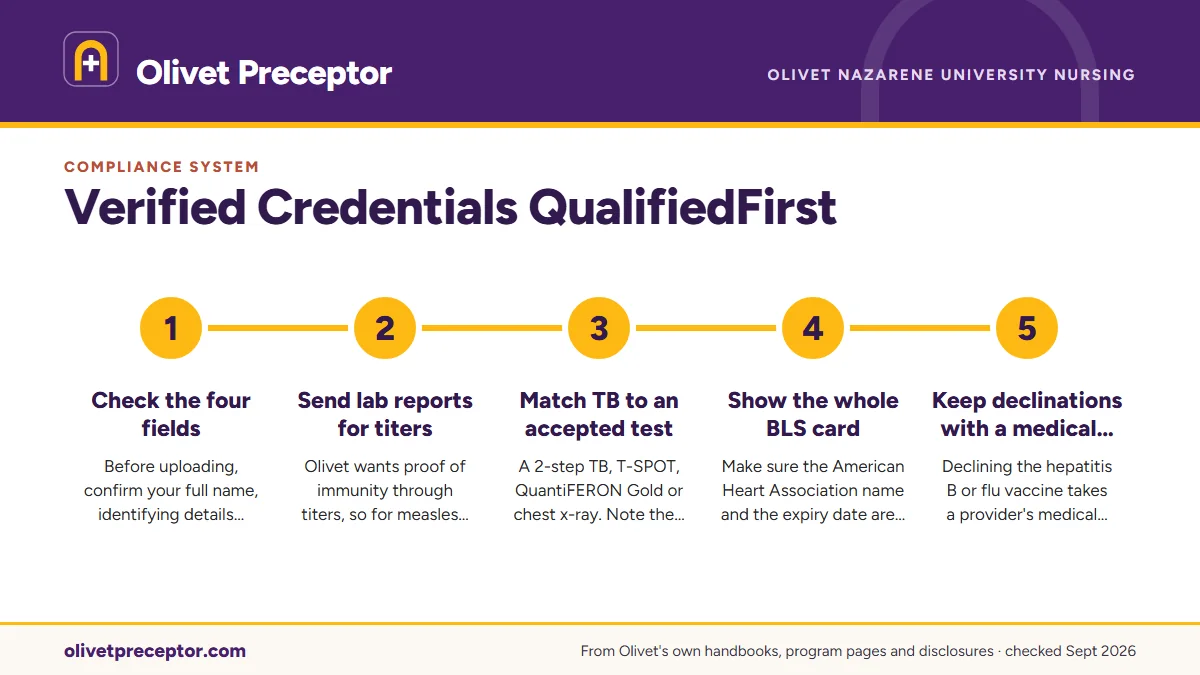
- Check the four fieldsBefore uploading, confirm your full name, identifying details, the result and the date appear on the page itself, not only in the file name.
- Send lab reports for titersOlivet wants proof of immunity through titers, so for measles, mumps, rubella, chickenpox and hepatitis B the lab result is the document that counts. A negative titer means a booster and then a repeat titer, which adds another round of lab work.
- Match TB to an accepted testA 2-step TB, T-SPOT, QuantiFERON Gold or chest x-ray. Note the date as you upload, since the result renews every year.
- Show the whole BLS cardMake sure the American Heart Association name and the expiry date are visible. The class must have been taken in person.
- Keep declinations with a medical statementDeclining the hepatitis B or flu vaccine takes a provider's medical statement, so have that statement ready to add to your record.
What QualifiedFirst costs, and who pays whom
Olivet's School of Nursing fee sheet prices compliance in two stages: a package for the first year, which bundles the background check, drug screen and compliance tracking, and then a renewal every year after. RN-BSN students pay QualifiedFirst directly for the background check and the drug test, and pay for Project Concert on top. For the amounts, look at the fee sheet itself and your requirements course. Because the renewal is yearly, a long FNP sequence can carry you past your first anniversary in the system, so budget for it as part of the program rather than as a surprise in the middle of a clinical course.
Some compliance costs sit outside the vendor entirely: your CPR class, titers and vaccines, the physical exam and your health insurance. Then come charges that depend on the site, for example a MyClinicalExchange fee where a site onboards through that platform. The placement costs page walks through the whole fee sheet line by line.
From admission to your first clinical day
- Consent at admissionYou agree to the background and drug-screening requirements when Olivet admits you.
- Orientation course invitationOlivet enrolls new-curriculum students automatically in a track-specific clinical or practicum orientation course. The invitation arrives by email and appears on your Canvas dashboard.
- Build the recordOrder the background check, collect titers and the physical, and upload each item to QualifiedFirst.
- Time the drug screenIts result has to clear no more than four and no fewer than two weeks before the practicum, so order it against your confirmed start date.
- VerificationProject Concert verifies the items, and the whole record has to be finished before you set foot in the clinical site.
- Keep it currentRenew yearly items before they lapse and keep BLS valid through the practicum.
The orientation course is where Olivet sets your track's detailed practicum rules; the requirements course page explains what it holds.
Why Olivet students choose us alongside QualifiedFirst
We treat your QualifiedFirst record as part of the placement itself. As soon as a preceptor and site look likely, we find out what the site's onboarding adds to Olivet's list and set the drug screen date against the confirmed start, so the record and the placement are ready on the same day.
We also collect the preceptor's credentials, license and site details that Olivet's approval asks for, so what the School of Nursing reviews arrives complete in one pass. The approval decision is Olivet's to make. If a preceptor withdraws partway through a course, we line up a replacement and tell you what the new site's onboarding adds to your record. Use the form below with your track and first clinical course, and we will build your timeline around it.
Questions Olivet students ask
Is Verified Credentials QualifiedFirst the same as CastleBranch?
They are two separate compliance vendors. Olivet's New Curriculum MSN/PG-APRN handbook names Verified Credentials QualifiedFirst, and the Current Curriculum handbook names CastleBranch for the same items. Use the one your handbook version names. If you are not sure which handbook governs you, the Online Advising Team can confirm it before you pay for a package.
Do NEL students use QualifiedFirst for their practicums?
Under the new-curriculum handbook, yes. Its compliance instruction reaches both NEL routes, the master's and the post-bachelor's certificate, just as it reaches the FNP tracks. Your record has to be complete before your first practicum day, which in the MSN NEL sample schedule is NRSG 604 Population Health, and current through NRSG 620.
Where do RN-BSN students upload TB and BLS records?
In Project Concert. The fall 2026 RN-BSN handbook sends your Tdap, TB, BLS and insurance records to Project Concert and keeps QualifiedFirst for the two screenings. Those screenings need clearing ahead of the palliative and end-of-life course, NRSG 364, and then carry you for twelve months of clinical hours.
How long does a QualifiedFirst record stay valid?
The handbook asks you to maintain every item, not just complete it once. TB and the flu vaccine renew yearly, BLS has to cover the whole practicum, and Olivet's fee sheet lists a yearly compliance renewal after the first-year package. What each renewal involves is spelled out in your requirements course.
Can I use health records from my employer?
The handbook judges the document, not its source: your identity, the result and the date all have to be on it. A record from an employer's occupational health office may pass that test, but acceptance of any particular document is settled through your requirements course, so ask the SON Clinical Coordinator first.
Related pages
Last checked 2026-09-25
We check these pages against Olivet's own handbooks, program pages, fee sheet and licensure disclosures. Your handbook version, your Canvas clinical requirements course, your faculty and the SON Clinical Coordinator have the final word.
Olivet asks you to start with your own network. We make the search the easy part of your program.
Tell us your Olivet track, where you live and when your next clinical course starts. We find preceptors whose patients fit the course, inside Olivet's approved states, and prepare everything Olivet's approval and the site's onboarding need.
- Preceptors matched to the course: adults and older adults for
NRSG 636C, women's health forNRSG 637C, children forNRSG 638C, education and leadership forNRSG 620 - Credentials, license and site details ready before your clinical course opens, with the drug screen timing on your calendar
- In your own community, in Illinois or any state Olivet approves for your clinicals
Start your placement plan
Track, city and start date is all we need to begin.