Olivet's new and current MSN curricula, side by side
Olivet Nazarene University's School of Nursing has two graduate handbooks in force: one for new starts, labeled New Curriculum, and one for students already enrolled, labeled Current Curriculum and last revised 8/31/26. Course numbers, the compliance vendor and the way you join the Canvas requirements course all differ between them, so settle which one governs you before you plan a single clinical hour.
Plan placements for your curriculum
Send us your track and the course numbers on your schedule. We build the preceptor plan around them.
How to tell which curriculum you are in
Olivet's library labels one MSN handbook New Curriculum and the other Current Curriculum, and the current one is marked effective for the August 31, 2026 start. Neither handbook says which start dates belong to which curriculum, so there is no date you can look up on your own. Your advisor on the Online Advising Team is the reliable answer.
Olivet's undergraduate splits are easier to read. The new RN-BSN curriculum applies to starts on or after August 23, 2026, and the new Traditional BSN plan to anyone starting Level 0 on or after August 24, 2026.
Signs you are in the current curriculum
- Your FNP clinicals are numbered
NRSG 665AtoNRSG 665F, or your education practicum isNRSG 634. - Your role course is
NRSG 627for FNP orNRSG 629for Education. - You enrolled yourself in the Canvas requirements course.
- Your compliance tracker is CastleBranch.
The opposite set of signs (NRSG 636C to NRSG 639C, a role course of NRSG 635 or NRSG 615, automatic enrollment, Verified Credentials QualifiedFirst) points to the new curriculum. If your signals are mixed, ask before you book a preceptor.
FNP courses side by side
| New curriculum | Current curriculum | |
|---|---|---|
| Role course | NRSG 635 Professional Role Development of the FNP-APRN | NRSG 627 APRN Role Development |
| 3P courses | NRSG 643, NRSG 644, NRSG 645 | NRSG 673/674, NRSG 675/676, NRSG 677/678 |
| Clinical courses | Four: NRSG 636C to NRSG 639C | Six: NRSG 665A to NRSG 665F |
| Paired didactic courses | NRSG 636 to NRSG 639 | NRSG 667 to NRSG 672 |
| Clinical hours | 240, 135, 135, 240 for 750 | 125 each once 665E and 665F rise, for 750 |
| FNP Immersion | NRSG 688 | NRSG 685 |
| Elective | None listed | NRSG 686 Virtual Clinical |
The biggest practical change is the shape of the clinical sequence. The new curriculum groups hours by population in four blocks. The current curriculum splits adult and geriatric care into acute and episodic, chronic and complex courses, then ends with a combined complex pediatric and women's health clinical. Both reach 750 hours, and the six older clinicals are walked through one by one in the NRSG 665 guide.
Education and leadership: same hours, new numbers
The education practicums keep their 30 and 120 hours in both handbooks. What moves is the numbering and the coursework around them, as the table shows.
| New curriculum (NEL) | Current curriculum (Education track) | |
|---|---|---|
| 30-hour practicum | NRSG 604 Population Health, 30 direct clinical hours | NRSG 658 Advanced Clinical Practice for the Academic Nurse Educator |
| 120-hour practicum | NRSG 620 Nursing Education and Leadership Practicum | NRSG 634 Nursing Education Practicum |
| Role course | NRSG 615 | NRSG 629 |
| Other courses | NRSG 601 to NRSG 603, NRSG 681, NRSG 630, NRSG 616 to NRSG 619, one MBA or MOL course | NRSG 653, NRSG 626, NRSG 607, NRSG 628, NRSG 641, NRSG 642, NRSG 679/NRSG 680 or NRSG 681, NRSG 621, NRSG 622, NRSG 624 |
In the new sample order the 30-hour course comes fourth, while the 120-hour practicum closes the program. That puts two separate preceptor searches at opposite ends of your studies: one in a population health setting, one with an educator or nurse leader.
The 120-hour course runs on its own clock, with an X grade and a 16-week outer limit; the NRSG 620 guide explains how it works.
Compliance vendor and the requirements course
The two handbooks name different compliance systems for the same list of items. The new handbook uses Verified Credentials QualifiedFirst, with Project Concert verifying each item. The current handbook sends the items, background check included, through CastleBranch. The item list itself does not change between the two; what changes is where you upload each record and which system tracks its dates.
Getting into the Canvas requirements course differs too. On the new side, Olivet places you in your track's clinical or practicum orientation course itself and sends the invitation by email, and the course also appears on your Canvas dashboard. Current-curriculum students add themselves to it before the role course opens, whether that is NRSG 627 in the FNP track or NRSG 629 in the Education track. Either way, that course is where your practicum rules are set, as the requirements course guide explains.
Credits and course numbers that crossed over
Credit figures depend on the document. The new handbook gives the MSN a range of 40 to 53 credits, the current handbook 33 to 53. The certificate figures spread wider still: 28 credits on the Post-Graduate APRN (FNP) web page, at least 37 according to the current handbook, and a 24-to-37 span that the new handbook applies to every certificate.
Some documents also mix numbers from both systems. A footnote in the new handbook's grading section refers back to the 665 series, and the exam entries on Olivet's fee sheet use older numbers such as NRSG 673/NRSG 674 and NRSG 667 to NRSG 671. A stray 665 or 667 in a new-curriculum document reads as a carry-over from the older system, not as a sign you were placed in it. If the numbers on your own registration look mixed, raise it with your advisor before you recruit for the wrong course.
What stays the same in both
Underneath the renumbering, the practicum basics carry across both handbooks and the program pages.
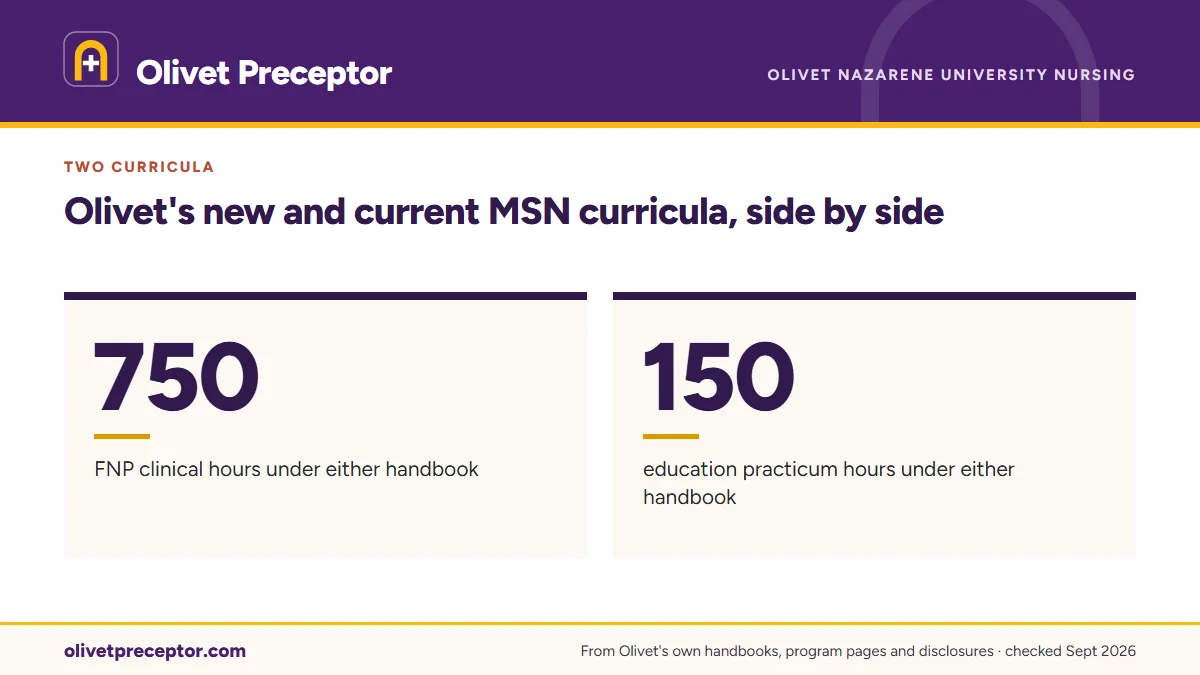
- 750 FNP clinical hours and 150 education practicum hours.
- A preceptor you choose and Olivet approves, near home and within an approved state.
- A compliance record completed ahead of day one and kept in date throughout.
- The 2,000 RN hours, with the close of
NRSG 681as the last date; the current handbook also wants them done beforeNRSG 665orNRSG 634starts. - Project Concert for competency tracking, a line item for both FNP and NEL students on the fee sheet.
The differences above are about numbering and systems, and the search for a preceptor who fits the course works the same way under both. Olivet approves every preceptor under either curriculum; preceptor approval covers what is and is not published about that step.
A placement plan built on your handbook
We start every Olivet plan by confirming which handbook governs you, because the course numbers decide how many preceptors you need and which patients each one must see. A current-curriculum FNP student needs up to six matches paced across NRSG 665A to NRSG 665F; a new-curriculum student needs four, two of them for 240 hours. Your plan also shows which searches can run side by side, so the next course's preceptor is being lined up while you log hours in the current one.
From there the placement desk finds each preceptor close to where you live and in a state Olivet approves, prepares the paperwork Olivet reviews along with each site's onboarding list, and tracks your deadlines in whichever compliance system your handbook names. Contact us with the course numbers on your schedule and we will build the plan around them.
Questions Olivet students ask
Can I move from the current curriculum to the new one?
Olivet's handbooks do not describe a route between the two curricula. If a leave, a failed course or a change of track makes you unsure where you will land, ask the Online Advising Team and your program director before registering, because the answer changes your course numbers, your clinical sequence and possibly your compliance system.
What does signing the handbook agreement commit me to?
The new handbook treats your signature as agreement that your track's Canvas requirements course governs your practicum. That course lives in Canvas and is not public, so read it closely once you have access. Preceptor criteria and approval steps are found there rather than on Olivet's web pages.
Do Post-Graduate FNP certificate students follow the new or current curriculum?
Both handbooks cover them. The new handbook places certificate students in NRSG 635, the 3P courses and then NRSG 636C to NRSG 639C. The current handbook marks the certificate's courses with an asterisk, beginning at NRSG 627, and asks for the 3P courses again only when a student's earlier passes fall outside a five-year window. Your advisor confirms which list is yours.
Is NRSG 686 Virtual Clinical required?
The current handbook lists NRSG 686 Virtual Clinical as an elective, and the new curriculum has no matching course. Its description and any link to clinical hours are set in the course itself, so ask your advisor before assuming it adds to, or stands in for, any of the hours in your six clinicals.
Related pages
Last checked 2026-09-25
We check these pages against Olivet's own handbooks, program pages, fee sheet and licensure disclosures. Your handbook version, your Canvas clinical requirements course, your faculty and the SON Clinical Coordinator have the final word.
Olivet asks you to start with your own network. We make the search the easy part of your program.
Tell us your Olivet track, where you live and when your next clinical course starts. We find preceptors whose patients fit the course, inside Olivet's approved states, and prepare everything Olivet's approval and the site's onboarding need.
- Preceptors matched to the course: adults and older adults for
NRSG 636C, women's health forNRSG 637C, children forNRSG 638C, education and leadership forNRSG 620 - Credentials, license and site details ready before your clinical course opens, with the drug screen timing on your calendar
- In your own community, in Illinois or any state Olivet approves for your clinicals
Start your placement plan
Track, city and start date is all we need to begin.