Who Does What in an Olivet Practicum
Olivet Nazarene University spreads a practicum across several roles and mailboxes, and writing to the right one first keeps a question moving. In short: the SON Clinical Coordinator handles preceptor help and license reports, the program directors decide withdrawals and appeals, GraduateNursing@olivet.edu reaches the program support coordinator, and the Online Advising Team handles address changes and leaves. Your course faculty evaluate your outcomes.
Get your placement plan
Tell us your Olivet program and where you live. A placement advisor replies with the preceptor and site options that fit your Olivet course.
The map at a glance
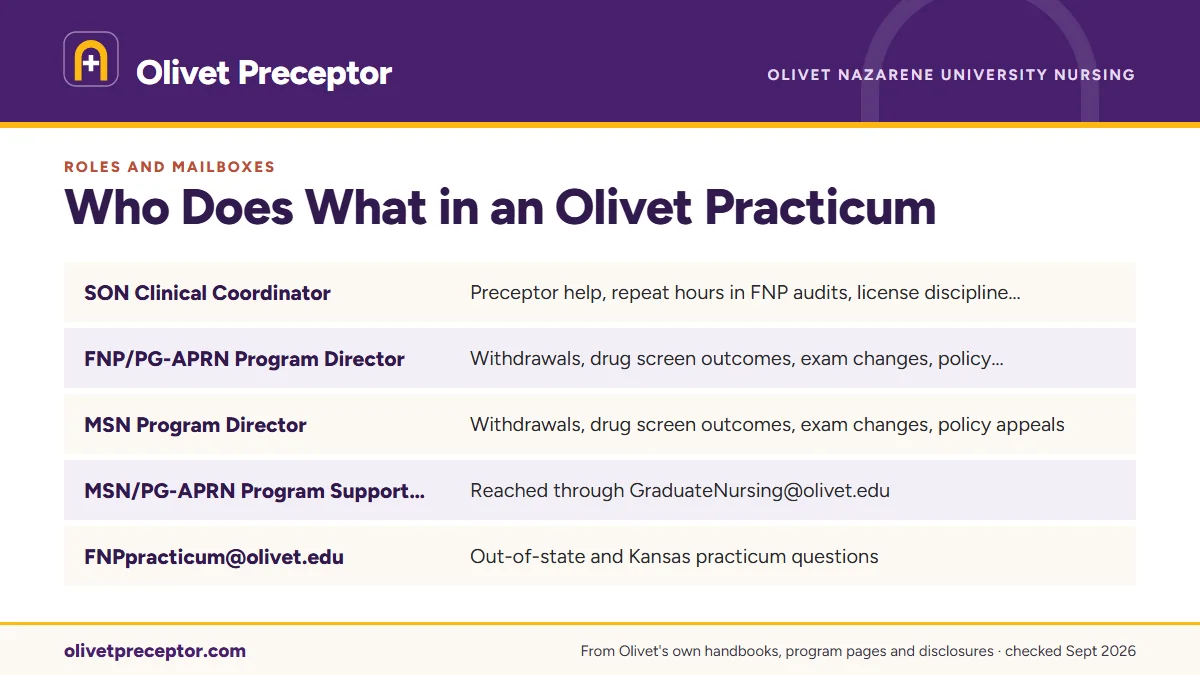
Olivet's handbooks and disclosures name each role by title. This table gathers them in one place, with the practicum jobs Olivet's own documents assign to each.
| Role or mailbox | What Olivet's documents give it | Who uses it |
|---|---|---|
| SON Clinical Coordinator | Preceptor help, repeat hours in FNP audits, license discipline reports passed on to the site | Graduate tracks |
| FNP/PG-APRN Program Director | Withdrawals, drug screen outcomes, exam changes, policy appeals; directs audit hours with the coordinator | FNP and PG-APRN |
| MSN Program Director | Withdrawals, drug screen outcomes, exam changes, policy appeals | MSN students |
| MSN/PG-APRN Program Support Coordinator | Reached through GraduateNursing@olivet.edu | MSN and PG-APRN |
| FNPpracticum@olivet.edu | Out-of-state and Kansas practicum questions | FNP |
| Online Advising Team | Address changes and leaves of absence, at onlineadvising@olivet.edu | Online students |
| Course faculty | Evaluate student outcomes and may ask preceptors for input | Every program |
| MSN Committee | Receives for-cause drug screen results | MSN |
| Academic Standards Committee | Hears formal policy appeals | Graduate students |
| Associate Dean, School of Nursing | Final step in the academic chain of command | Every program |
| bsnpracticum@olivet.edu | Receives legacy RN-BSN preceptor paperwork | RN-BSN, core before August 2026 |
The SON Clinical Coordinator
The coordinator is the Olivet role most tied to your preceptor. On the FNP program page, the coordinator steps in with the school's resources and networks once a student has made 30 unsuccessful attempts, and the site found that way may sit outside your preferred location. The PG-APRN and MSN-NEL pages describe substantial support from the coordinator with no attempt count, a difference the 30-attempt rule page sets out in full.
Two other duties land here. If your RN license becomes encumbered, you tell the coordinator, who tells your practicum site. And when an FNP or PG-APRN student audits a course, the coordinator and the FNP Program Director decide how many of its clinical hours are repeated, up to 50%. The SON Clinical Coordinator page covers how to work with this role.
Program directors and the support coordinator
The FNP/PG-APRN Program Director and the MSN Program Director hold the decisions that change the shape of a program: withdrawals, what happens after a drug screen result, changes to exams and appeals of a policy. When a question has an answer that could move your graduation date, it usually ends on a director's desk.
The MSN/PG-APRN Program Support Coordinator is the practical front door. Olivet's MSN handbooks point graduate students to GraduateNursing@olivet.edu for this role, and both handbooks also name that mailbox for out-of-state questions. For a routine program question that does not fit a narrower mailbox, it is the natural place to start.
A positive drug screen shows how these roles connect. Olivet's handbook withdraws the student from all courses and reports the result to IDFPR and/or the licensing state, directors handle the outcome, and a for-cause result goes to the MSN Committee. The drug screen page covers the timing and what the screen includes.
Mailboxes, and the one Olivet conflict
Olivet names four email addresses around practicums. GraduateNursing@olivet.edu reaches the MSN/PG-APRN support coordinator. FNPpracticum@olivet.edu is the address in Olivet's FNP licensure disclosure for out-of-state questions and for Kansas, which has added state requirements. onlineadvising@olivet.edu reaches the Online Advising Team. bsnpracticum@olivet.edu receives preceptor paperwork for RN-BSN students who began core before August 2026.
The conflict: for an FNP question about practicing in another state, the disclosure file names FNPpracticum, while both MSN handbooks name GraduateNursing. Neither document mentions the other address. Writing to FNPpracticum with GraduateNursing copied covers both documents, and the reply will tell you which one Olivet prefers for your case. The licensure disclosures page explains the state list behind these questions.
Olivet's FNP disclosure and its MSN handbooks name different mailboxes for out-of-state questions. Copy both until Olivet tells you which to use.
Committees and the chain of command
Two committees appear in the graduate handbook. The MSN Committee receives for-cause drug screen results. The Academic Standards Committee hears formal policy appeals, the step after a decision you want reviewed. Olivet places the Associate Dean of the School of Nursing at the end of the academic chain of command, so a concern starts with the person closest to it, usually your course faculty, and moves up only when it needs to.
Leaves of absence run through Online Advising rather than a committee. The Return Form is due to Olivet a full two weeks ahead of your first day back in clinical or practicum work, which matters when a preceptor is holding a start date for you. The leave and delays page covers X grades, Incompletes and pausing mid-program.
Other offices appear in the handbook for needs outside the practicum itself: Online Admissions, Student Financial Services, the Registrar, the IT Help Desk, and Accessibility and Disability Resources.
Bachelor's programs: different roles, different rules
The Traditional BSN runs on a campus team. The Level 0 handbook gives placements to the clinical coordinator, while the Levels 1 to 4 handbook gives them to the BSN director and faculty; level coordinators run each level, and capstone assignments are made by the BSN Program Director or by whoever teaches the NURS 449/NURS 478 didactic course. The handbooks also name the Admission, Progression, and Retention Committee, and the nursing administrative assistant who collects CPR cards. BSN students are barred from reaching out to sites or would-be preceptors on their own.
In the legacy RN-BSN, students send the Preceptor Information Form, and the Agency Affiliation Agreement when needed, to bsnpracticum@olivet.edu, and the Program Director approves exceptions. Under the Fall 2026 RN-BSN handbook, the instructions for the background check and drug screen arrive by email while NRSG 302 is running or soon after, and no role is named for arranging the hospice and community sites.
Where our placement desk fits among them
Olivet students choose us because we give them one contact for the part of the practicum that takes the most time: finding the preceptor. The desk searches close to home and within the states Olivet approves, pulls together the license, credentials and practice details Olivet looks at, and keeps every compliance deadline visible.
Every Olivet role keeps its own decisions: Olivet approves your preceptor, and your faculty evaluate your work. Our part is making sure the packet in front of Olivet is finished, so your emails to the coordinator are about approval rather than missing pieces. When a preceptor drops out mid-course, the same desk handles the replacement. How it works shows each step, and the form below starts yours.
Questions Olivet students ask
Who approves my preceptor at Olivet?
Olivet does. Its program pages describe the graduate preceptor as approved and self-selected, but they do not name the office, the form or the time approval takes. Your Canvas requirements course is where Olivet sets out those steps, and our preceptor approval page lists what to prepare before you submit.
Does my preceptor grade me in an Olivet clinical course?
Your faculty own the evaluation. Olivet's handbook lets them ask a preceptor for input, but judging your outcomes stays with them. FNP clinicals carry a Satisfactory or Unsatisfactory grade, and passing any clinical or practicum course takes an 83% average across graded work plus satisfactory documentation of every hour.
Who do I tell at Olivet if I move during my program?
The Online Advising Team, at onlineadvising@olivet.edu. Olivet asks students to report any change of address, and FNP students should also check the board rules of the new state, since practicum hours are allowed only in approved states. See moving during your program for the rest.
Who can I appeal to if I disagree with a clinical decision?
Olivet's graduate handbook lists policy appeals among the program directors' duties, with formal appeals heard by the Academic Standards Committee and the Associate Dean of the School of Nursing as the last step in the chain of command. Read the appeal process in your own handbook version, since the new and current curricula have separate books.
Is there an Olivet office that assigns graduate preceptors?
Not as a first step. Olivet expects FNP, PG-APRN and NEL students to open the search through people they already know. The FNP page brings in the SON Clinical Coordinator, with the school's own networks, once 30 attempts have come up empty; the PG-APRN and NEL pages describe substantial support without a count. Traditional BSN placements, by contrast, are all assigned.
Related pages
Last checked 2026-09-25
We check these pages against Olivet's own handbooks, program pages, fee sheet and licensure disclosures. Your handbook version, your Canvas clinical requirements course, your faculty and the SON Clinical Coordinator have the final word.
Olivet asks you to start with your own network. We make the search the easy part of your program.
Tell us your Olivet track, where you live and when your next clinical course starts. We find preceptors whose patients fit the course, inside Olivet's approved states, and prepare everything Olivet's approval and the site's onboarding need.
- Preceptors matched to the course: adults and older adults for
NRSG 636C, women's health forNRSG 637C, children forNRSG 638C, education and leadership forNRSG 620 - Credentials, license and site details ready before your clinical course opens, with the drug screen timing on your calendar
- In your own community, in Illinois or any state Olivet approves for your clinicals
Start your placement plan
Track, city and start date is all we need to begin.