Illinois APRN Practice and Who Precepts You
Every nurse practitioner who precepts you in Illinois works one of two ways: under a written collaborative agreement with a physician, or with full practice authority earned after 4,000 hours as a licensed APRN. For an Olivet Nazarene University FNP student, that difference shapes the clinic you train in, the prescribing you watch and the license path you follow after graduation.
Get your placement plan
Tell us your Olivet program and where you live. A placement advisor replies with the preceptor and site options that fit your Olivet course.
Two ways an Illinois NP practices
Illinois requires a written collaborative agreement for APRN practice, with a short list of settings exempt from it. An APRN who reaches full practice authority no longer needs the agreement. Preceptors come from both groups, and either can give you a strong clinical, but the paperwork behind their practice, and some of what you will see them do, differs.
Full practice authority is spreading quickly. Illinois counted 3,144 FPA licenses in June 2024 and 4,756 by December 1, 2025, 3,753 of them at Illinois addresses. Set that beside the 17,087 active certified nurse practitioners the state counted in October 2025 and FPA holders are still a minority, so many preceptors you meet will work under an agreement or in an exempt setting.
Inside a collaborative agreement
In the agreement, the NP and the physician spell out their working relationship and list the kinds of care the NP delivers. For nurse practitioners, the physician does not have to be on site. Consultation happens in person or by telecommunication, as the agreement sets out, and the rule text fixes no meeting schedule.
Prescribing runs through delegation. The physician delegates prescriptive authority in writing and notifies IDFPR of the agreement and of any controlled substance delegation, Schedules II to V. With that in place, the APRN applies for IDFPR's mid-level controlled substances license. Delegating Schedule II drugs requires the APRN to show 45 graduate contact hours in pharmacology, and ending an agreement has to be reported within 10 days.
For you as a student, this means your preceptor's scope follows their agreement. You may meet the collaborating physician or never see them, and your preceptor can explain which categories of care and which drugs the agreement covers.
Where an agreement is not required
Two official sources list the exempt settings differently, and the difference is worth knowing if you train at a community health center.
| Setting | IDFPR qualification sheet (effective 10/2025) | Rule text, 68 IAC 1300.410 |
|---|---|---|
| Hospital | Exempt | Exempt |
| Hospital affiliate | Not named | Exempt |
| Federally qualified health center | Exempt | Not named |
| Ambulatory surgical treatment center | Exempt | Exempt |
| APRN with full practice authority | Handled through the separate FPA license (277) | Exempt |
Until the two align, treat the FQHC exemption as a question for IDFPR rather than a settled fact. For a student it is mostly background, but it explains why two NPs in similar clinics can describe their arrangements differently.
Full practice authority: the seasoned preceptor
FPA asks a lot. The APRN needs current, unrestricted Illinois RN and APRN licenses, at least 4,000 hours of clinical work in the certified specialty logged after first national certification while licensed as an APRN, with collaborating physicians or hospital medical staff attesting to those hours, and at least 250 hours of continuing education in that specialty. The license is IDFPR's 277, with a separate FPA controlled substances license, the 377, for each location that stores or dispenses.
FPA prescribing still has limits you will notice in clinic. Benzodiazepines and Schedule II narcotics require consultation with a physician and documented checks of the state's prescription monitoring program, and opioids and benzodiazepines are limited to oral, topical or transdermal forms. An FPA preceptor has years of practice behind them; in the state's 2024 FPA survey, 24% of active FPA licensees were 55 or older.
What this means when Olivet reviews a preceptor
Illinois practice status is not what decides who can precept you; Olivet's criteria are. Olivet sets them in the Canvas requirements course for your track and signs off on each preceptor. Full practice authority appears nowhere in Olivet's public preceptor wording, and if you hope to learn from a physician or a PA, raise it with your course faculty or the SON Clinical Coordinator before you ask them.
Olivet's FNP disclosure file notes that certain states add their own preceptor qualification or documentation rules for APRN licensure, so if you plan to practice outside Illinois, check that state as well; Olivet's licensure disclosures show where FNP hours are allowed. The preceptor requirements page covers what Olivet publishes, and preceptor approval covers the approval step.
Your own path to Illinois practice after Olivet
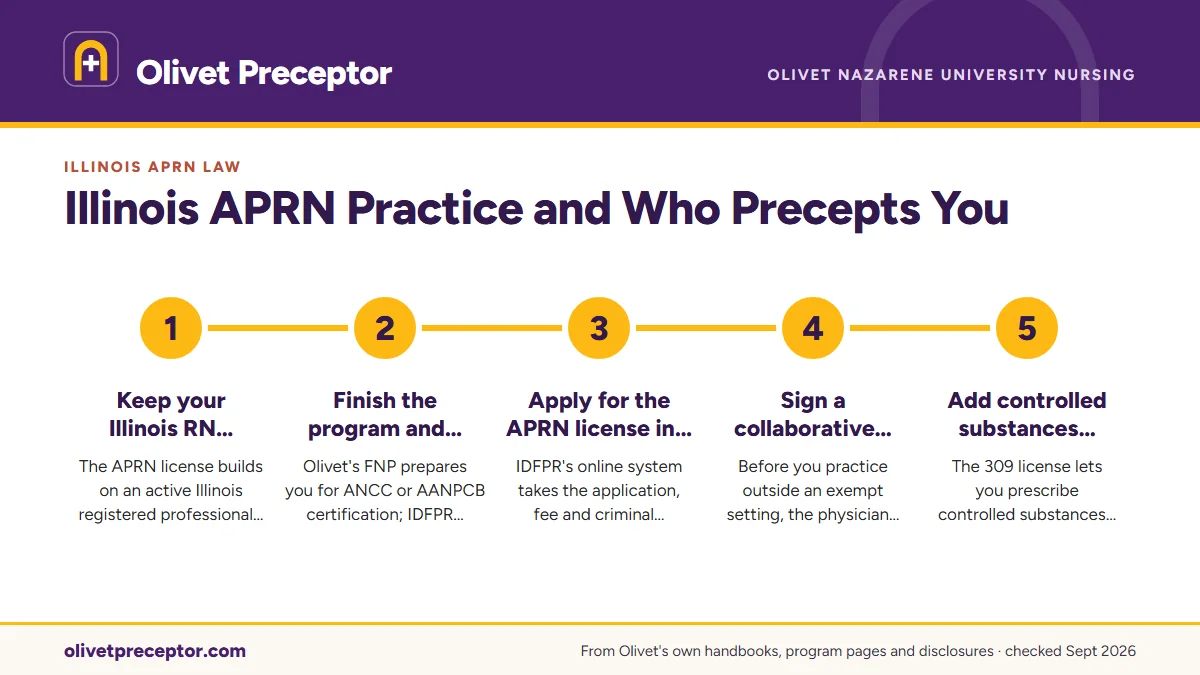
- Keep your Illinois RN license currentThe APRN license builds on an active Illinois registered professional nurse license.
- Finish the program and certifyOlivet's FNP prepares you for ANCC or AANPCB certification; IDFPR accepts AACN, AANPCB, ANCC, NCC and PNCB for nurse practitioners.
- Apply for the APRN license in COREIDFPR's online system takes the application, fee and criminal history records check. Since July 2024, IDFPR accepts the RN, APRN and controlled substances applications in one filing.
- Sign a collaborative agreementBefore you practice outside an exempt setting, the physician on the agreement notifies IDFPR of it and of any prescriptive authority delegated to you.
- Add controlled substances authorityThe 309 license lets you prescribe controlled substances under delegation; Schedule II needs proof of 45 graduate pharmacology contact hours.
- Work toward full practice authorityAfter 4,000 APRN clinical hours and 250 CE hours in your specialty, apply for FPA and its controlled substances license.
Why Olivet students choose us in Illinois
We know how Illinois NPs practice, so before you commit we can tell you whether a preceptor works under an agreement or with full practice authority, what their clinic's setting means for your days, and whether their patients fit your Olivet course. That saves you from discovering a mismatch in week one.
Then we prepare the preceptor details Olivet's approval needs, keep your compliance dates on track and stay with you through the hours. If you train in Kankakee County or the Chicago area, the same search covers system clinics, community health centers and independent practices. Illinois NP preceptors explains what the state's health systems ask of schools.
Questions Olivet students ask
Does my Illinois preceptor need full practice authority?
Olivet's public pages do not list full practice authority as a preceptor requirement, and Illinois's nursing code sets its preceptor rule only for pre-licensure RN programs. Olivet's own criteria, found in your track's requirements course in Canvas, are what count. An NP practicing under a collaborative agreement can be an excellent preceptor when the patients fit your course.
Do I need a collaborative agreement lined up before I graduate?
Not to graduate. You need an agreement before you practice as an APRN in Illinois outside the exempt settings, and the collaborating physician files notice of it with IDFPR. Because the setting decides whether an agreement is needed at all, ask about it while you are interviewing for your first NP role, and plan it alongside your APRN license application.
Which certification exams does Illinois accept for nurse practitioners?
IDFPR's APRN qualification sheet lists AACN, AANPCB, ANCC, NCC and PNCB certification for nurse practitioners. Olivet points its FNP graduates toward the ANCC and AANPCB family nurse practitioner exams. National certification comes before the Illinois APRN license, so plan the exam date around your final clinical and the FNP Immersion.
Can I file my Illinois APRN and controlled substances applications together?
Yes. Since July 24, 2024, IDFPR lets APRNs apply for the controlled substances license at the same time as the underlying license, and the RN, APRN and APRN controlled substances applications can be filed together. The FPA licenses can be filed as a group as well once you qualify for them.
Why does it matter whether my clinic is a hospital or a health center?
The setting decides whether the NP there needs a collaborative agreement. Hospitals and ambulatory surgical treatment centers are exempt in both official lists; federally qualified health centers are exempt on IDFPR's sheet but not named in the rule text. For your clinical it mostly affects how your preceptor's physician relationship works, not what you learn.
Related pages
Last checked 2026-09-25
We check these pages against Olivet's own handbooks, program pages, fee sheet and licensure disclosures. Your handbook version, your Canvas clinical requirements course, your faculty and the SON Clinical Coordinator have the final word.
Olivet asks you to start with your own network. We make the search the easy part of your program.
Tell us your Olivet track, where you live and when your next clinical course starts. We find preceptors whose patients fit the course, inside Olivet's approved states, and prepare everything Olivet's approval and the site's onboarding need.
- Preceptors matched to the course: adults and older adults for
NRSG 636C, women's health forNRSG 637C, children forNRSG 638C, education and leadership forNRSG 620 - Credentials, license and site details ready before your clinical course opens, with the drug screen timing on your calendar
- In your own community, in Illinois or any state Olivet approves for your clinicals
Start your placement plan
Track, city and start date is all we need to begin.