Olivet Traditional BSN clinicals: assigned by the school
Olivet Nazarene University assigns every Traditional BSN clinical from its Bourbonnais campus, so students focus on learning while the school arranges the sites. This page walks through those placements level by level, then shows where our preceptor service fits later in your career: Olivet's RN-BSN and online graduate programs, where students find their own preceptors.
Planning your next step?
Thinking ahead to Olivet's MSN or a certificate? Tell us your plans and your placement advisor will follow up.
How Olivet assigns BSN clinicals
The Traditional BSN is Olivet's on-campus nursing program, taught in Wisner Hall for Nursing Education in Bourbonnais, home to the Virtual Learning Center and simulation manikins. Every clinical placement is set by the school. The Level 0 handbook says the clinical coordinator assigns students to clinical groups and sites, and that students have no choice in placement except for capstone requests.
The Levels 1 to 4 handbook places that job with the BSN director and faculty and says students may not contact clinical sites or potential preceptors. The two handbooks name different people, but they agree on the rule that matters: the school arranges the placement, and students leave all site contact to the school.
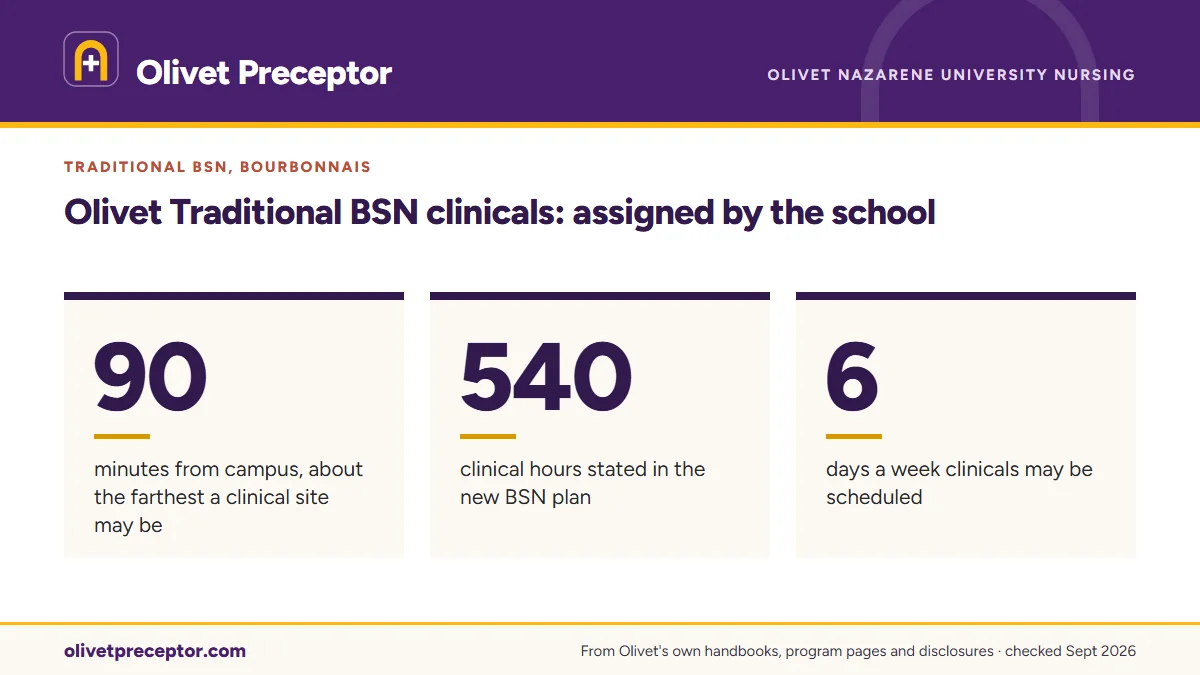
Placements can be about 90 minutes from campus, and students provide their own transportation. Clinical shifts can start as early as 5:00 a.m. and end as late as 11:00 p.m., on any of six days each week, so reliable transportation and a flexible schedule are part of the program.
Contacting a clinical site or potential preceptor yourself breaks the BSN handbook rule, so route every placement question through your clinical coordinator or faculty.
Clinical hours by level in the new plan
The new plan covers anyone who enters Level 0 on or after August 24, 2026, where 1 credit hour equals 45 clinical or lab hours. Clinical courses carry the site hours the school assigns, while the Bridging Theory and Practice immersion courses carry lab hours.
| Level | Clinical courses and hours | Lab immersion |
|---|---|---|
| Level 0 (sophomore spring) | NURS 201 Principles of Nursing, 45 | None |
| Level I (junior fall) | NURS 220 Health & Wellness Across the Lifespan, 45 | NURS 222 Immersion I, 135 |
| Level II (junior spring) | NURS 250 Alterations of Health Across the Lifespan, 135 | NURS 252 Immersion II, 135 |
| Level III (senior fall) | NURS 310 Acute & Complex Health Conditions Across the Lifespan, 135 | NURS 312 Immersion III, 90 |
| Level IV (senior spring) | NURS 474 End of Life and Specialty Topics, 45; NURS 471 Population Health, 45, online over 7 weeks; NURS 478 Capstone, 90 | NURS 472 Immersion IV, 90 |
The plan states 540 clinical plus 495 lab hours, 1,035 in all. Its own level subtotals add to 990, and the listed lab courses add to 450 lab hours, so ask your level coordinator if you need an exact figure. Level IV is split into Block I and Block II, and NURS 473 Practice Ready Leadership is where the 20 verified community service hours are submitted.
Students already in Levels 1 to 4
Students in Levels 1 to 4 in Fall 2026 follow the legacy plan, which totals 720 clinical hours at 45 clock hours per clinical credit. It opens with NURS 202 Introduction to Professional Nursing (45 hours), then moves through Health Assessment and Fundamentals (NURS 206, NURS 207), Adult Health I and Mental Health (NURS 349, NURS 342), Adult Health II, Childbearing Family and Child Health (NURS 439, NURS 378, NURS 415), and finally Community Health and the capstone (NURS 335, NURS 478).
Level totals in that plan are 135 hours at Level I, 135 at Level II, 180 at Level III and 225 at Level IV. Your handbook version decides which plan applies, and the versions also differ on the entrance exam: the Level 0 handbook and the fee sheet use the ATI TEAS before NURS 201, while the Levels 1 to 4 handbook uses the HESI A2 before NURS 202.
The capstone: assigned, and never on your own unit
NURS 478 is the capstone: 90 clinical hours in the new plan and a 4-credit clinical course in the legacy plan. Under the Levels 1 to 4 handbook, either the BSN Program Director or the professor teaching the NURS 449/NURS 478 didactic course decides where each capstone happens. The Level 0 handbook allows capstone requests, the one point where a student's preference may be weighed.
Your own work unit is off-limits for the capstone. Capstone preceptors are assigned rather than chosen, and they sign each shift evaluation. Across the program, faculty use a Daily Clinical Evaluation tool, and if a facility cancels a clinical day, the hours are made up in the Virtual Learning Center.
ROTC Nurse Summer Training Program cadets can count part of that training toward capstone time, though they still complete set capstone days, including ER and ICU rotations.
Compliance keeps you in your level
BSN compliance carries high stakes because a gap removes you from the level, not just from a shift. The Level 0 handbook lists these items.
- Background check and drug screen on entering the program and every year after
- Physical exam
- Initial 2-step TB, then yearly
- MMR and varicella, two doses each or titers, Tdap, and the 3-dose hepatitis B series
- Yearly flu vaccine; an exemption form is due no later than the semester before your first rotation, and each facility decides whether to accept it
- AHA BLS taken in person, and personal health insurance
Let any item lapse and you are withdrawn from the level and must repeat it. Site orientation and site-specific requirements are due by the clinical coordinator's deadline, and if a site asks for a student to be removed, the student fails the level. Our background check and immunizations and TB pages explain how those items work across Olivet's programs.
Where we fit for Traditional BSN students
Your BSN rotations are arranged by Olivet from start to finish, and that is a real advantage: your energy goes into learning, hitting compliance deadlines and preparing for the NCLEX-RN.
Our work begins where Olivet's online programs hand the search to the student. The MSN FNP, the Post-Graduate FNP certificate and the MSN NEL all expect students to open the preceptor search through their own circle of colleagues and contacts, and the FNP adds a requirement of 2,000 hours of RN work, due by the close of NRSG 681. The nurses, managers and nurse practitioners you meet on BSN rotations are the start of that network, so stay in touch with the ones who taught you well.
When you are ready for graduate study, we are the most thorough way to line up preceptors for Olivet's graduate clinicals, from the first population health hours to the final FNP clinical. The MSN FNP and MSN NEL pages show what each program asks. If a friend or colleague with an ADN is weighing Olivet's RN-BSN, those practicum hours happen in their own community, and we help there too.
Questions Olivet students ask
Can I get licensed in another state after Olivet's BSN?
Olivet's BSN licensure disclosure rates the program as meeting requirements in all 50 states, with each state last reviewed in 2024. Because that review is not recent, check the board of nursing in the state where you plan to work. For Illinois, the handbook points graduates to IDFPR to apply for the NCLEX-RN.
Do Olivet BSN students need their own liability insurance?
For full-time BSN students, the Levels 1 to 4 handbook says the University assumes responsibility for the student. Your own required items are the compliance list: background check and drug screen, physical, TB, immunizations, in-person BLS and personal health insurance. Ask your clinical coordinator if a particular site requests anything beyond that list.
What HESI score does Olivet require before the NCLEX?
The Levels 1 to 4 handbook says a HESI Exit Exam score of 900 or more is required before Olivet releases a student to test. Graduates of the BSN are eligible for the NCLEX-RN, so the exit exam is the last academic gate between finishing the capstone and sitting the licensing exam.
How do Olivet's 8-week blocks line up with BSN clinicals?
The residential calendar splits each semester into 8-week blocks. For Fall 2026, Block I runs August 24 to October 18 and Block II October 19 to December 13; spring classes begin January 11, 2027, and Commencement is May 8, 2027. In the new plan, Level IV is split into Block I and Block II, and NURS 471 runs online over 7 weeks.
When should a BSN graduate think about graduate preceptors?
Olivet's MSN FNP expects 2,000 hours of RN experience before NRSG 681 is over, and each of Olivet's online graduate tracks starts the preceptor search with the student's own network. Once you are working as an RN and have picked a track, reach out, and your placement advisor will plan the search around your first clinical or practicum course.
Related pages
Last checked 2026-09-25
We check these pages against Olivet's own handbooks, program pages, fee sheet and licensure disclosures. Your handbook version, your Canvas clinical requirements course, your faculty and the SON Clinical Coordinator have the final word.
Olivet asks you to start with your own network. We make the search the easy part of your program.
Tell us your Olivet track, where you live and when your next clinical course starts. We find preceptors whose patients fit the course, inside Olivet's approved states, and prepare everything Olivet's approval and the site's onboarding need.
- Preceptors matched to the course: adults and older adults for
NRSG 636C, women's health forNRSG 637C, children forNRSG 638C, education and leadership forNRSG 620 - Credentials, license and site details ready before your clinical course opens, with the drug screen timing on your calendar
- In your own community, in Illinois or any state Olivet approves for your clinicals
Start your placement plan
Track, city and start date is all we need to begin.